
I didn’t come to this realization in a single lightbulb moment. Instead, it crept up on me gradually.
It happened every time a student told me they’d “fixed” an essay overnight—but couldn’t explain the changes they’d made.
It happened when I saw them using AI to generate answers, not because they wanted to cheat, but because they genuinely believed it was just a tool.
It happened as I planned a discussion on Frankenstein and kept returning, again and again, to the same unsettling parallel: They weren’t just analyzing Victor’s choices. They were making the same ones.
Students, like Victor, often see only the promise of AI—the efficiency, the convenience, the way it removes obstacles—without fully considering how it reshapes their learning process, their thinking, and their sense of ownership over their work.
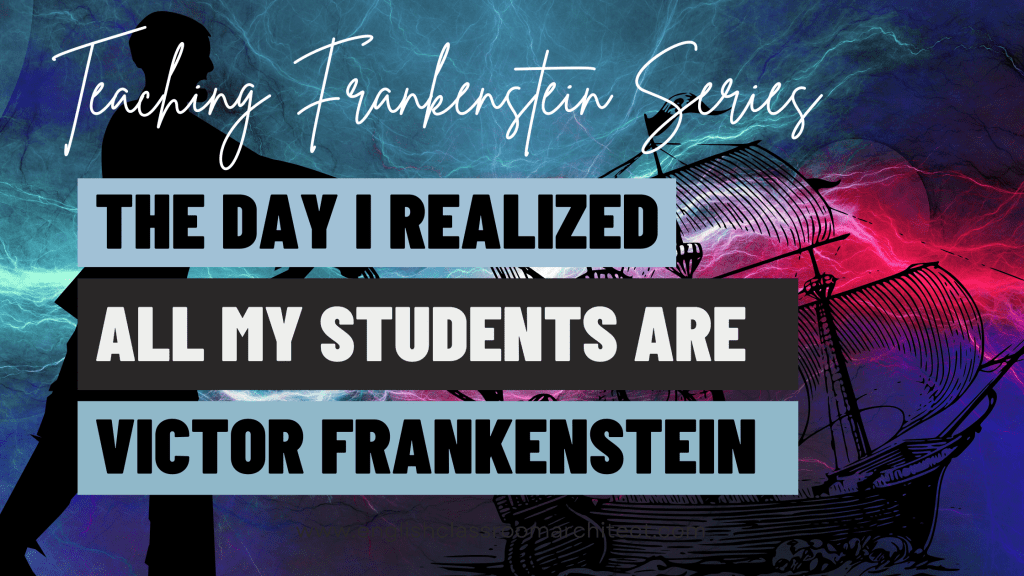
Table of Contents
Shelley’s Blurred Lines: Victor, the Creature, and the Power of Creation
As much as Victor Frankenstein and his creation seem like opposites—the brilliant university student versus the outcast monster—Shelley blurs the line between them in so many interesting ways. Through language, characterization, and even their shared feelings of isolation and regret, Shelley invites us to question: Who is the real monster? Who is truly in control?
The more I thought about my students and their use of AI, the more I saw these same blurred identities. Are they Victor, eagerly pushing technology forward without fully grasping the consequences? Or are they the creature, shaped by an educational system that demands perfection, forcing them to turn to AI as a way to survive?
Victor and the Creature: Two Sides of the Same Coin
One of the most striking ways Shelley collapses the boundaries between Victor and the creature is through their language. Victor’s horror at the creature’s existence is laced with an eerie sense of recognition:
“I beheld the wretch—the miserable monster whom I had created.”
There’s this moment later in the novel where the creature, in turn, describes himself in almost identical terms:
“I, the miserable and the abandoned, am an abortion, to be spurned at, and kicked, and trampled on.”
Both see themselves as miserable. Both feel abandoned. Both blame external forces for their suffering. In the end, Victor and his creation are locked in an endless cycle where neither fully claims responsibility for the other.
This mirroring is exactly what I see when students use AI. On the surface, they are the creators, generating essays, discussion responses, and even analysis with the push of a button. But the moment they are confronted about what they’ve done—whether it’s a teacher questioning their understanding or their own realization that they can’t explain their work—many feel trapped by what they’ve made.
Just like Victor, students often distance themselves from their own creations:
- “I just used AI to get started, but I changed a few things!”
- “It wasn’t really me who wrote it—it was AI.”
- “I didn’t even mean to use it that much, it just kind of happened.”
Victor chooses to pursue questionable knowledge. He ignores his professors’ warnings about outdated alchemy and dangerous pursuits, and his education is shaped by his own unchecked ambition rather than ethical consideration.
Like Victor, they chase the thrill of innovation but struggle with accountability.
When Students Become the Creature
But there’s another layer to this: Many students aren’t just Victor. They’re also the creature—shaped by an educational system that rewards the final product over the learning process.
Consider the creature’s painful realization of his place in the world:
“I ought to be thy Adam; but I am rather the fallen angel, whom thou drivest from joy for no misdeed.”
Unlike Victor, the creature wants to learn. He absorbs knowledge from Paradise Lost, Plutarch’s Lives, and The Sorrows of Werter—not questionable sources, but profound, complex texts. The problem isn’t what he’s learning, but that he’s learning without guidance. No teacher helps him make sense of these works, to contextualize them, to challenge his assumptions. Instead, he is left to piece together an identity from fragmented, sometimes contradictory ideas.
Isn’t this how many students feel in an academic system that prioritizes speed and correctness over exploration and revision? If they rely on AI to write their essays, is it because they’re lazy—or because they feel they have to in order to keep up?
Victor, by contrast, chooses to pursue dangerous, unchecked knowledge. He ignores the guidance of his professors, believing that their ideas are too limiting. He seeks knowledge for power and personal glory, rather than for understanding.
If we apply this to students using AI, we might ask:
- Are they like the creature, desperately seeking knowledge but left to navigate it alone?
- Or are they like Victor, using AI as a tool to chase success without fully considering its implications?
In both cases, the lack of structured reflection and ethical guidance creates problems—not the tool itself.
The Core Question: Who is in Control?
By the end of Frankenstein, it’s unclear whether Victor was ever really in control of his creation. He wanted to play god, to build something brilliant, but he never considered what would happen once his creation had a life of its own.
This is the exact tension we see with AI:
- Do students control it, or does it start to control them?
- Is it empowering them, or is it making them dependent?
- Do they even realize when they’ve crossed the line?
When we ask students to reflect on these questions, we aren’t just discussing literature—we’re helping them understand their own relationship with technology.
Because in the end, Frankenstein isn’t just about a scientist and his creation. It’s about power, responsibility, and the unintended consequences of progress—which makes it one of the most relevant texts we can teach today.
If our students are navigating the same ethical dilemmas as Victor, Walton, and the creature, then the next step is helping them understand which role they’re playing—and whether they’re comfortable with that choice.
The Three Archetypes: Victor, Walton, and the Creation
If Shelley blurs the lines between Victor and the creature, she also gives us a third figure to consider: Walton, the ambitious explorer who eagerly seeks knowledge but hesitates at the edge of disaster.
As I reflected on my students’ use of AI, I realized they weren’t all just “playing God” like Victor. Some were more like Walton, fascinated by AI’s potential but aware of the risks. Others felt trapped by the system and turned to AI as a survival mechanism—more like the creature than the scientist.
The way students use AI sorts them into one of these three roles, shaping their relationship with learning and ethical decision-making.
Archetype 1: The Victors – The Innovators Who Push Without Limits
“Learn from me, if not by my precepts, at least by my example, how dangerous is the acquirement of knowledge…”
Some students approach AI the way Victor approaches scientific discovery: with unrestrained ambition. They see AI as a shortcut to mastery, not a tool for thinking.
Traits of the Victor Student:
- Uses AI to push boundaries and experiment
- Prioritizes results over the process of learning
- Justifies AI use as “working smarter”
- Rarely questions the long-term consequences
AI in Action – The Victor Mindset:
- The student who uses ChatGPT to generate an essay, changes a few words, and submits it as their own.
- The student who rationalizes AI use by saying, “This just saves me time,” without considering whether they’re actually learning.
- The student who views AI as an extension of themselves—not a separate tool, but a way to offload intellectual effort.
The Risk? Like Victor, these students may not fully grasp the consequences of their actions. They could be sacrificing deep thinking for efficiency, losing sight of their own intellectual agency.
Archetype 2: The Waltons – The Curious But Cautious Explorers
“One man’s life or death were but a small price to pay for the acquirement of the knowledge which I sought.”
Robert Walton, the ambitious yet reflective explorer, mirrors students who see AI’s potential but hesitate before diving in completely. They are curious, sometimes even excited, but also wrestle with ethical concerns and wonder what AI’s role in education should be.
Traits of the Walton Student:
- Experiments with AI but doesn’t rely on it
- Asks ethical questions about its impact
- Uses AI for idea generation or revision rather than full reliance
- Values learning over shortcuts
AI in Action – The Walton Mindset:
- The student who uses AI to brainstorm ideas but still writes their own essay.
- The student who asks, “Is it wrong to use AI for this?” rather than assuming it’s fine.
- The student who tests AI’s capabilities out of curiosity, not as a replacement for thinking.
⚖️ The Strength? Unlike Victor, Walton has a moment of self-awareness—he ultimately chooses not to pursue destruction at all costs. These students are the ones who will shape the future of AI use responsibly if we help them navigate its complexities.
Archetype 3: The Creations – The Survivors Shaped by the System
“I ought to be thy Adam, but I am rather the fallen angel…”
Then, there are students who don’t see AI as a choice—they see it as a necessity. These students aren’t trying to push boundaries like Victor or explore new ideas like Walton. They use AI because they feel like they have no other option.
Traits of the Creation Student:
- Uses AI to cope with academic pressures
- Feels disconnected from their own learning
- Views AI as a survival tool rather than a creative one
- Lacks confidence in their own writing or thinking
AI in Action – The Creation Mindset:
- The student who turns to AI because they feel overwhelmed and believe they can’t meet expectations on their own.
- The student who says, “I don’t even know where to start,” and lets AI take over.
- The student who, like the creature, learns in isolation—without structured guidance or mentorship—leading to disjointed, impersonal work.
💔 The Risk? These students may end up detached from their own academic growth, feeling like they’re merely assembling assignments rather than creating them.
So What Do We Do With This?
If we recognize these patterns in our students, what’s our responsibility as educators?
The goal isn’t to eliminate AI or force students into rigid roles. Instead, we need to help them reflect on the role they’re playing—and whether they’re comfortable with it.
- If a student is a Victor, they need guidance in ethical decision-making and consequence awareness.
- If a student is a Walton, they need opportunities to engage in critical discussions about AI’s potential and limits.
- If a student is a Creature, they need support, mentorship, and confidence-building strategies so they don’t feel AI is their only option.
The key question we should ask students isn’t “Are you using AI?”—because most of them are. It’s:
“How are you using AI—and are you in control of it, or is it in control of you?”
If our students are already making ethical choices—whether they realize it or not—then our job isn’t to ban AI. It’s to help them understand the responsibility that comes with using it.
Start With Their Reality
Instead of beginning with Victor’s choices, start with their own experiences using AI.
Discussion Prompt: What’s the most tempting way to use AI in school?
At first, they’ll probably joke about AI writing their essays or doing their homework for them. But the more they talk, the more they’ll start unpacking the actual tensions they feel:
- “I use it to generate ideas, but then I feel like I didn’t really come up with them.”
- “I don’t trust my writing as much anymore because I always check if AI can do it better.”
- “I don’t even know what counts as cheating and what doesn’t.”
Now they aren’t discussing someone else’s ethical dilemma. They’re discussing their own.
Once students see their own ethical struggles, they can identify parallels in Frankenstein—but this time, with real stakes.
Allow for Complexity
The biggest mistake we make in ethics discussions is forcing students into simplistic right/wrong thinking.
AI use isn’t a binary moral choice. It’s a series of micro-decisions—some intentional, some unconscious—that shape how students engage with learning.
Encourage them to explore the gray areas:
- Is using AI for grammar suggestions the same as using it to write an entire essay?
- If AI helps students learn better, is it wrong to use it?
- Where’s the line between using AI as a tool and becoming dependent on it?
- If AI improves accessibility for students who struggle with writing, should it be restricted?
The most powerful ethical discussions happen not when students find the “right” answer, but when they realize there may not be one.
If we recognize these patterns in our students, how do we guide them to make better decisions?
Banning AI isn’t the solution. Teaching students to grapple with its ethical complexities is. And that means helping them see the responsibility that comes with creation.
Frankenstein Resources
Read the Teaching Frankenstein Series:
- Ice, Ambition, and AI: Teaching a Powerful Frankenstein Intro
- Teaching Frankenstein Like It’s 1818 Isn’t Working Anymore
- The Day I Realized My Students Are All Victor Frankenstein
- Beyond ‘Don’t Use AI’: Creating Meaningful Discussions About Technology Ethics
- Using Origin Stories to Make Frankenstein Click for Gen Z
- Not Another Essay: Rethinking How We Assess Frankenstein
Grab the Resources:

 Skip to content