


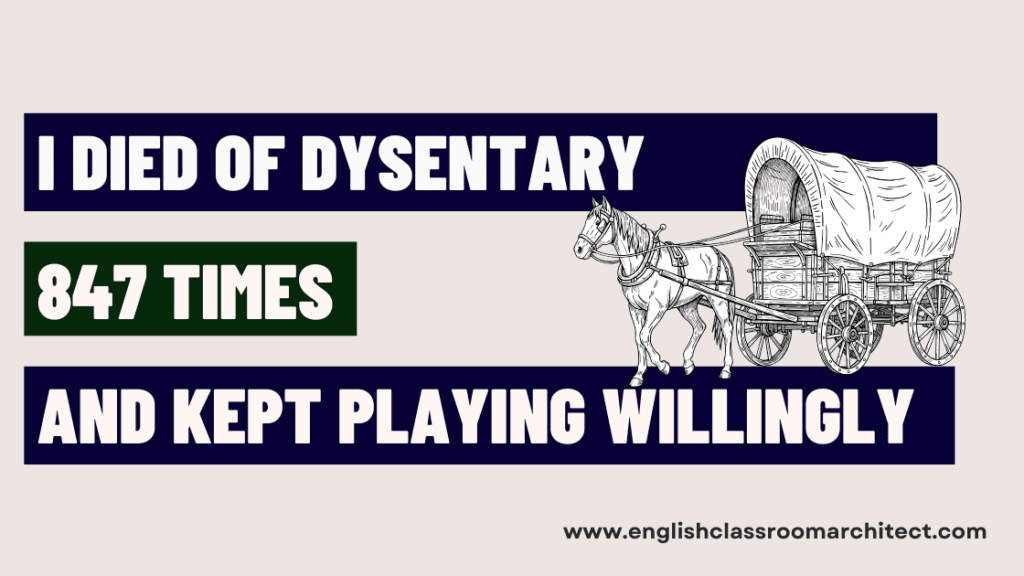
I died of dysentery approximately 847 times in elementary school computer lab. And I kept playing.
Think about that: students were begging for the chance to fail repeatedly at something genuinely difficult. No participation trophies. No gentle redirection when Mary broke her leg. Just honest feedback and the irresistible urge to try again.
What did that pixelated pioneer simulator understand about learning that we’ve somehow forgotten? Oregon Trail made failure feel like learning, not punishment. And in 2025, when AI can eliminate all struggle from student work, we desperately need to remember why struggle matters.
Table of Contents
Inside This Episode:
- “Students lined up to die of cholera—there’s something we need to understand here” – What Oregon Trail got right about productive struggle that modern education has forgotten
- “We’ve accidentally taught students that confusion means they’re doing something wrong” – How “accessible” often means “pre-digested” and why that eliminates learning
- “What if struggle isn’t a bug, it’s the entire feature?” – The conceptual shift that changes how you design curriculum
- “AI can’t struggle for them, and that’s actually perfect” – Why the work AI cannot do is exactly the work that creates learning
- “The magic wasn’t that it was a game. It was that the struggle felt purposeful” – Four ways to design Oregon Trail moments in your English classroom
- “If your students aren’t struggling a little, they’re probably not learning much” – Why difficulty should signal importance, not impossibility
What Oregon Trail Got Right About Learning
Students lined up to die of cholera. There’s something we need to understand here.
Oregon Trail wasn’t sophisticated. The graphics were primitive. The gameplay was repetitive. But something about it made failure feel like information instead of judgment.
The Oregon Trail Learning Formula
Immediate, honest feedback with no sugar-coating
The game didn’t soften the blow. “Mary has died of dysentery.” Not “Mary is having a challenging health moment.” The feedback was clear, direct, and immediate.
Clear connection between choices and consequences
You could see cause and effect. Spent too much on ammunition? You’ll run out of food. Forded the river in April? Your wagon tips over. The game respected students enough to let them fail.
Failure as information, not judgment
Dying didn’t mean you were bad at Oregon Trail. It meant you learned something: don’t ford rivers in April. Failure taught you something useful for the next attempt.
Students choosing difficulty because the goal mattered
Nobody made students play Oregon Trail. They chose to struggle with it because getting to Oregon felt meaningful. The difficulty was part of what made it engaging, not what made it frustrating.
The insight: Students will choose productive struggle when the struggle serves a purpose they care about.
The Modern Struggle Problem in Education
We’ve accidentally taught students that confusion means they’re doing something wrong.
How Confusion Became a Problem to Solve
In our rush to make learning “accessible” and “engaging,” we’ve eliminated the very thing that creates learning: productive struggle.
Confusion has become:
- A signal to rescue rather than a signal to persist
- Evidence of inadequacy rather than evidence of growth
- Reason to simplify rather than reason to support
- Teacher failure rather than learning process
“Accessible” often means:
- Pre-digested to the point of meaninglessness
- Simplified until there’s no complexity left to grapple with
- Robbed of the productive struggle that creates actual learning
- Safe but shallow
Why Students Avoid Challenge
Students shut down at the first sign of difficulty because:
- They’ve learned failure means inadequacy, not information
- They’ve been rescued too quickly too often
- Confusion feels like being bad at something
- They don’t have experience pushing through difficulty to competence
- We’ve told them (implicitly) that if it’s hard, they’re doing it wrong
The result: Students who can ace tests but can’t think. Who can follow directions but can’t navigate ambiguity. Who optimize for grades without learning anything.
They’ve learned to avoid struggle entirely. And in doing so, they’ve learned to avoid learning.
Productive Struggle vs. Overwhelming Frustration: The Distinction We’re Missing
Not all difficulty is productive. There’s a crucial difference between productive struggle and overwhelming frustration.
Productive Struggle Feels Like:
- “This is hard but I can figure it out”
- Clear goal, uncertain path to get there
- Feedback that helps me adjust my approach
- Failure that teaches me something useful
- Challenge that matches capability (barely)
Overwhelming Frustration Feels Like:
- “I have no idea what’s even being asked”
- No clear goal or path forward
- No feedback, or confusing feedback that doesn’t help
- Failure that just confirms I’m bad at this
- Challenge that exceeds capability by too much
The Problem We Created
We’ve conflated the two. So we’ve eliminated ALL struggle to avoid overwhelming students.
And in doing so, we’ve eliminated learning.
Because learning doesn’t happen when information flows in easily. Learning happens when your brain has to work to make connections, persist through confusion, and struggle toward understanding.
Remove the struggle, remove the learning.
The Reframe: Struggle IS the Point
What if struggle isn’t a bug in the learning process—it’s the entire feature?
The Conceptual Shift
Current assumption:
- Good teaching makes things easy to understand
- Confusion means we haven’t explained well enough
- If students are struggling, we need to simplify
- Accessibility means removing difficulty
The reframe:
- Good teaching makes difficult things worth struggling with
- Confusion means students are encountering genuine complexity
- If students aren’t struggling, they’re probably not learning
- Accessibility means making struggle productive, not eliminating it
Why This Matters: How Learning Actually Works
Your brain doesn’t change when information flows in easily.
Neural pathways strengthen when you have to work to make connections. The difficulty IS what creates the learning. The struggle is the mechanism.
This explains:
- Why students forget material they “understood” in class
- Why summarized/simplified versions don’t stick
- Why study guides don’t create retention
- Why students can pass tests but can’t transfer knowledge
They never struggled with it. So they never really learned it.
The AI Connection: Why This Is Urgent Now
AI can’t struggle for students. And that’s actually perfect.
AI can:
- Give them answers instantly
- Explain concepts clearly
- Simplify complexity
- Produce polished final products
- Eliminate all difficulty from schoolwork
But AI cannot do the cognitive work of:
- Wrestling with confusion
- Making unexpected connections
- Persisting through difficulty
- Building tolerance for complexity
- Experiencing the satisfaction of figuring something out
The work AI can’t do? That’s the work that creates learning.
So our job isn’t to compete with AI by being clearer or faster. Our job is to create conditions where productive struggle is irresistible.
Just like Oregon Trail did in 1985.
Teaching Strategies: Designing Oregon Trail Moments in English Class
The magic wasn’t that Oregon Trail was a game. It was that the struggle felt purposeful.
Here’s how to create that same energy in your English classroom:
Strategy 1: Frame Challenging Texts as Worthwhile, Not Obstacles
Instead of: “This text is difficult, so let me explain it first”
Try:
- “This text is difficult. That’s why it’s worth reading.”
- “You will be confused. That means it’s working.”
- “First read is for noticing what confuses you—that’s the data we need.”
- Frame confusion as information, not failure
The shift: Difficulty signals importance, not impossibility.
When I teach Macbeth, I don’t apologize for the language being hard. I tell students: “This is genuinely difficult. Shakespeare isn’t making it easy on you. That’s why people still read it 400 years later—because it requires you to think.”
The students who believe me? They lean in. The struggle becomes the point.
Strategy 2: Create Low-Stakes Opportunities for Productive Struggle
Design practice spaces where:
- Failure is expected and useful
- Feedback is immediate
- Stakes are low enough to take risks
- The struggle itself is the explicit goal
Structures that work:
- Daily annotation practice where you EXPECT them to be confused—”Mark three things that confused you and what you tried to figure them out”
- Discussion protocols where building on confusion is required—no resolving it, just complicating it productively
- Reading journals tracking “what confused me and what I tried”—making the struggle visible and valued
- Drafting explicitly labeled “bad first drafts welcome”—removing the pressure to be right immediately
The principle: Normalize struggle as part of the process, not evidence of failure.
Strategy 3: Design Assignments That Require Struggle
Oregon Trail assignment characteristics:
- Goal is clear (survive to Oregon / analyze power dynamics in Macbeth)
- Path is uncertain (many ways to get there)
- Choices have consequences (immediate feedback on thinking)
- Failure teaches you something (revision based on what didn’t work)
Design moves:
- Require showing your thinking, not just the answer
- Build in revision based on feedback—multiple attempts expected
- Make the messy middle visible and valued
- Celebrate productive wrong turns that taught something
Example: Instead of “Write an essay about ambition in Macbeth,” try:
“Trace three moments where a character makes a choice about ambition. Show me your thinking about what drives each choice and what the consequences reveal. First draft will be messy—that’s expected. We’ll workshop it and you’ll revise based on what you discover.”
Clear goal. Uncertain path. Multiple attempts. Struggle is the work.
Strategy 4: Use Discussion as Productive Struggle Space
Instead of: Teacher asks question → student gives answer → teacher evaluates
Try:
- Student makes claim → other students complicate it → thinking evolves
- No “right answer” to discover, just better thinking to build
- Teacher’s role: create conditions for struggle, not resolve it
- Productive confusion that leads somewhere
The goal: Students leaving MORE confused than they arrived, but productively so.
I run Socratic seminars where the explicit goal is “Leave with better questions, not final answers.” Students know we’re not looking for resolution—we’re building intellectual stamina for complexity.
That’s productive struggle. That’s Oregon Trail energy.
What These Strategies Share
All of these approaches create conditions where:
- Difficulty is framed as desirable, not an obstacle to overcome
- Failure provides useful information, not judgment
- Multiple attempts are expected, not evidence of inadequacy
- The struggle itself is valued, not just the outcome
This is what Oregon Trail understood: The difficulty IS the engagement.
The Cultural Context Advantage: Why 90s References Work
Here’s something else Oregon Trail got right: It was culturally neutral.
Nobody worried about:
- Political implications of dysentery
- Whether wagon wheel metaphors might be problematic
- How to make pioneers relevant without controversy
It was just safe to engage with.
Compare that to teaching literature today. You want to make Romeo and Juliet relevant, but current examples of family conflict or teenage rebellion come with baggage that turns your English class into a political debate.
This is why I use 90s cultural references:
- Recent enough to be accessible
- Distant enough to be safe
- Rich enough to create meaningful struggle moments
- Without the controversy
When I teach narrative structure using Buffy the Vampire Slayer cold opens or decision-making using Iron Chef, students can focus on the analytical work without the cultural landmines of current examples.
Want to explore this approach? I’ve created a free crash course on using 90s cultural references to build those safe-but-challenging spaces for productive struggle. Download the crash course.
Resources Mentioned in This Episode
Teaching Resources
Free 90s Cultural References Crash Course
Learn how to use 90s pop culture to create safe spaces for productive struggle in your English classroom. Includes frameworks, examples, and ready-to-use activities.
Oregon Trail Context of the Week
How to apply game design principles to assignment design and help your students understand how they can apply them to your life.
Related Content
Episode 81: “‘6-7’ Word of the Year and We’re Living in Idiocracy”
Why celebrating meaninglessness matters for education and what teaching actually resists.
Context of the Week: Idiocracy & WALL-E
Teaching students to recognize cultural patterns around convenience vs. capability
About Anti-Burnout for English Teachers
Anti-Burnout for English Teachers is for experienced high school English teachers who are tired of surface-level professional development. Each episode offers intellectually rigorous conversations about what literacy education should be doing right now—with practical frameworks you can use Monday morning.
Host: Danielle is an 18-year veteran English teacher teaching English 10 Honors and teamed English 10 with multilingual learners. She runs English Classroom Architect, serving experienced teachers who want intellectually rigorous, systems-based solutions for sustainable teaching.


 Skip to content