


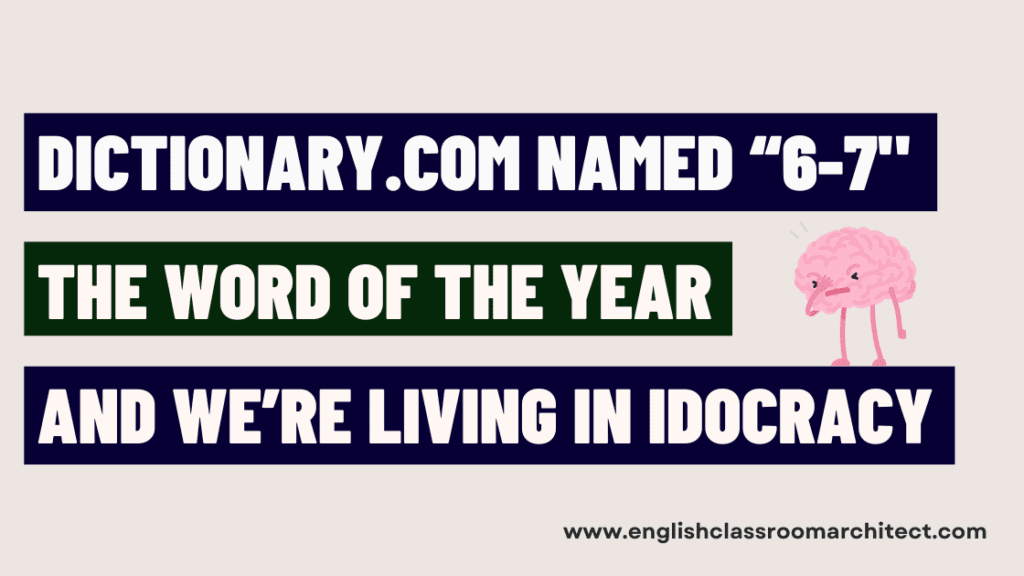
Dictionary.com just announced their 2025 Word of the Year: “6-7.”
Not a word. Two numbers from a viral song that literally means nothing. They described it as “meaningless, ubiquitous, and nonsensical… it has all the hallmarks of brainrot.” And they’re celebrating it.
As a teacher in week 10 of the school year, this explains SO MUCH about what I’m seeing in my classroom right now. Because here’s what’s happening: We’re not just dumbing things down anymore. We’ve crossed into a different territory. We’re actively celebrating emptiness as content.
If you’ve seen the movie Idiocracy, this should feel uncomfortably familiar.
What You’ll Talk About in This Episode:
- “We’ve been building toward this for 200 years” – The pattern of American anti-intellectualism from Legend of Sleepy Hollow to the Quiz Show scandal
- “They’re channeling Brom Bones rejecting Ichabod Crane” – Why students asking “Why do we need to know this?” is culturally coherent
- “Charles Van Doren had all the answers—none of the understanding” – What the 1950s Quiz Show scandal reveals about performance vs. substance
- “If meaninglessness is the only thing that can become universal anymore…” – What it means that ‘6-7’ broke through every algorithm
- “Appearance over substance. Performance over meaning.” – Five examples of anti-intellectualism in education we’re not naming
- “These aren’t extras. These ARE the actual work of education” – Six teaching strategies that resist optimization culture
Why ‘6-7’ Word of the Year Matters for Teachers
Students know ‘6-7’ is empty. That’s the joke. It’s knowingly meaningless, and they’re celebrating that emptiness as content.
My first instinct as a teacher? Frustration. You’re choosing to be vapid. You KNOW it means nothing, and that’s somehow the point?
But I also understand something else: This is one of the few truly shared cultural moments this generation has. In a world of hyper-personalized algorithms where everyone’s feed is different, ‘6-7’ is universal. Everyone knows it. It broke through every bubble.
And understanding that context doesn’t make me feel better. It makes me feel worse.
Because if meaninglessness is the only thing that can become universal anymore—if empty content is what unites an entire generation—then we’re not just losing intellectual rigor. We’re losing the capacity for shared meaning itself.
Table of Contents
American Anti-Intellectualism: From Legend of Sleepy Hollow to Today
This isn’t new. America has always had a paradoxical relationship with intellectualism: we rail against it while desperately wanting to be the best at everything.
1819: Legend of Sleepy Hollow and Early American Anti-Intellectualism
Washington Irving wrote a story where the intellectual outsider gets chased out of town by the practical man of action. Ichabod Crane, the book-smart schoolteacher, loses to Brom Bones. The community rejects intellectual refinement in favor of physical prowess.
Here’s what’s wild: The story itself is sophisticated literary craft. America was celebrating its own anti-intellectualism IN literature.
1950s: The Quiz Show Scandal and Performance Over Substance
During the Cold War, America desperately wanted to prove we were the smartest nation. Quiz shows became performances of intelligence. Charles Van Doren—Columbia professor, handsome, articulate—was the perfect intellectual.
Except it was all theater. The shows were rigged. We wanted the appearance of brilliance without the actual rigor. Everyone knew it was fake but watched anyway.
The scandal revealed what we’d been doing all along: valuing performance over substance.
2025: How ‘6-7’ Continues the Pattern
Revolutionary period → 1950s → 2020s. Same cultural move, repeated.
We celebrate anti-intellectualism while demanding to be the best at everything. We want:
- Credentials without learning
- Appearance without substance
- Winning without doing the intellectual work
‘6-7’ being named Word of the Year isn’t an aberration. It’s the latest iteration of American cultural DNA. We’ve been training for this moment for 200 years.
The difference: Now we have technology that enables it at scale. AI isn’t the cause, but it is the accelerant.
What Teachers Are Seeing in Classrooms Right Now
So when I see this playing out in my classroom, I’m not just seeing TikTok brain rot. I’m seeing 200 years of American cultural conditioning coming home to roost.
Students aren’t stupid. They’re smart. They’re just optimizing for what gets rewarded:
- Performance over substance
- Credentials over understanding
- Appearance over meaning
- Metrics over learning
They want to be “the best” without doing the intellectual work. And honestly? We trained them to do exactly this.
When a student asks “Why do we need to know that?” they’re channeling Brom Bones rejecting Ichabod Crane.
When they use AI to perform intelligence without thinking, they’re doing what Charles Van Doren did on those quiz shows—looking smart without being smart.
When they chase A’s without learning anything, they’re being perfectly American.
This isn’t rebellion. It’s cultural coherence.
Five Examples of Anti-Intellectualism in Education Today
This pattern shows up everywhere in education:
Students Getting A’s Without Learning
- Grade optimization without understanding
- Can ace the test, can’t apply the knowledge
- Memorize for assessment, forget immediately
- We reward this with college admission, then wonder why they can’t think
Productivity Theater in Teaching
- Looking busy vs. doing meaningful work
- Teachers drowning in data entry that improves nothing
- Documentation instead of action
- Performance of productivity, not actual work
AI-Generated Content That Sounds Right But Means Nothing
- Grammatically correct emptiness
- Can’t tell it’s AI because there’s no “there” there
- Quiz show answers sounded smart too—but they were scripted, not thought
Debate as Performance vs. Truth-Seeking
- Winning > discovering
- Sides > understanding
- Students trained to “win” discussions not learn from them
Administrative Compliance Without Learning
- Documenting everything, learning nothing
- Creates appearance of accountability
- Metrics without meaning
- We’re all Charles Van Doren now—performing for the cameras
The common thread: Appearance over substance. Performance over meaning. Optimization over understanding. This is what America has always rewarded.
Teaching Strategies That Resist Optimization Culture
Teaching for meaning isn’t just good pedagogy—it’s resistance. Against 200 years of American anti-intellectualism. Against optimization culture. Against the Idiocracy timeline.
It’s about building capacity for:
Building Capacity for Complex Thinking
- Macbeth doesn’t fit in a TikTok
- Some ideas require sustained attention
- Nuance matters, gray areas exist
- Answers that raise more questions
Collaborative Meaning-Making in the Classroom
- Students building ideas together, not just consuming
- Discussion protocols that require building on others’ thinking
- Interdependence not independence
- Can’t just watch and absorb
Teaching Questions Without Simple Answers
- Legitimacy, power, ambition—no clean moral
- Living with uncertainty
- Multiple interpretations coexisting
- The opposite of quiz show culture
Argument as Truth-Seeking Not Performance
- Genuinely trying to understand
- Being changed by what others say
- Surprise as goal, not winning
- Can’t fake this with AI
Process Over Product: Portfolio Assessment
- Portfolio assessment not one-shot tests
- Show your thinking, not just answer
- Revision as learning
- Can’t perform your way through this
Human Judgment That AI Can’t Replicate
- Evaluation that requires context
- Understanding that requires relationship
- Connection to specific classroom conversations
- Can’t be outsourced or automated
These aren’t extras. These ARE the actual work of education—especially in a culture that’s been celebrating meaninglessness for 200 years.
Every one of these runs counter to optimization culture. They’re slow, messy, inefficient. They can’t be measured easily and they require actual humans in actual relationship.
Resources Mentioned in This Episode
Films & Books Referenced
- Idiocracy (2006) – Mike Judge film about anti-intellectualism and empty spectacle
- “The Legend of Sleepy Hollow” – Washington Irving (1819)
- Quiz Show (1994) – Film about the 1950s scandal
About Anti-Burnout for English Teachers
Anti-Burnout for English Teachers is for experienced high school English teachers who are tired of surface-level professional development. Each episode offers intellectually rigorous conversations about what literacy education should be doing right now—with practical frameworks you can use Monday morning.
Host: Danielle is an 18-year veteran English teacher, currently teaching English 10 Honors and teamed English 10 with multilingual learners. She runs English Classroom Architect, serving experienced teachers who want intellectually rigorous, systems-based solutions for sustainable teaching.

 Skip to content