
Every October, Edgar Allan Poe gets his annual resurrection.
Ravens appear on bulletin boards. Students write “Tell-Tale Heart” parodies. English teachers dust off the same Gothic unit they’ve been teaching for years. Poe becomes shorthand for “spooky old writer guy,” all brooding genius and tragic romance, with maybe a black cat thrown in for good measure.
But here’s something I’ve been thinking about: the cartoon version of Poe we’ve created is so much tidier than the actual man. And in making him simple, in turning him into a Halloween decoration, we’ve accidentally erased something more interesting and actually more revealing about America itself.
The real Poe wasn’t just tragic. He was contradictory, messy, strategic, and relentlessly reinventing himself in ways that should feel uncomfortably familiar to anyone living in modern America.
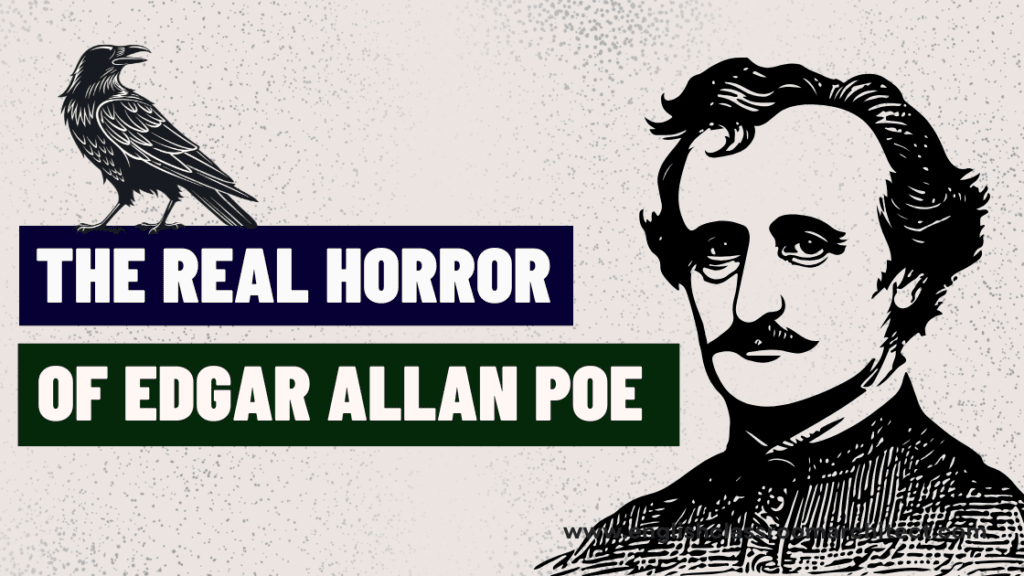
Table of Contents
The Ghost of His Childhood
Let’s start with what most people know: Poe was orphaned at two years old when his mother died of tuberculosis and his father disappeared. The Allan family of Richmond took him in—gave him their name, raised him in their household, sent him to good schools.
But here’s the part that matters: they never actually adopted him.
Think about what that means for a kid. You have a family. You use their name. You live in their house. But you don’t legally belong to them. You’re always one step away from secure, always proving yourself, always aware that your place in this family is conditional.
This isn’t just biographical trivia. It’s the psychological architecture that shows up everywhere in Poe’s work. That unstable sense of identity, that feeling of belonging-but-not-quite-belonging, the precariousness of relationships and it runs through almost everything he wrote.
The narrators who can’t trust their own minds. The doppelgangers who aren’t sure which one is real. The houses that collapse because their foundations were never solid to begin with.
We read these as Gothic conventions, but they’re also the lived experience of someone who spent his entire childhood in a family that never made his belonging permanent.
The Shape-Shifter
Here’s something most October Poe celebrations skip entirely: the man reinvented himself constantly, deliberately, and strategically.
At eighteen, he enlisted in the U.S. Army under the name “Edgar A. Perry” This is not his real name, but he was not running from debt or crime; he’s just trying on a different identity. He excelled as a soldier, rising to the rank of sergeant major (the highest enlisted rank possible) in less than two years. This wasn’t the work of someone passively drifting through life. This shows he was good at being a soldier.
Then he got himself into West Point, where he proceeded to deliberately engineer his own expulsion. He skipped formations, refused to attend classes, racked up 44 offenses and 106 demerits in one term, then topped that with 66 offenses in a single month. According to court-martial records, he was found guilty of “Gross neglect of Duty” and “Disobedience of Orders.”
What I see? This is someone actively experimenting with different versions of himself. He’s a soldier, scholar, critic, editor, poet, Gothic visionary. Each identity was deliberately constructed then deliberately abandoned when it no longer served his purposes.
And this pattern of unstable identity, of performing different selves, shows up everywhere in his fiction. William Wilson and his double. The narrator of “The Black Cat” who can’t explain his own actions. The characters in “The Masque of the Red Death” who think they can wall themselves off from their own nature.
Poe understood something about American identity that we’re still grappling with: the freedom to reinvent yourself also means you’re never quite sure who you actually are.
The Critic with Claws
Here’s what gets lost when we turn Poe into a Halloween decoration: the man made his living primarily as a critic and literary magazine editor, not as a Gothic writer.
He was sharp, strategic, and often brutal. His caustic reviews earned him the nickname “the Tomahawk Man,” a reputation he seemed to cultivate deliberately. In his review of Hawthorne’s Twice-Told Tales, he praised the craft but eviscerated what he saw as heavy-handed allegory. He championed the “single effect,” the idea that every word should contribute to one unified emotional impact, in short stories.
And then there was the Longfellow situation. Starting in 1840 and continuing through what became known as “the Little Longfellow War” in 1845, Poe accused Henry Wadsworth Longfellow of plagiarism. Not copying words verbatim (our modern understanding), but appropriating ideas, meters, rhythms, and images. He called it “the most barbarous class of literary robbery; that class in which, while the words of the wronged author are avoided, his most intangible, and therefore least defensible and least reclaimable property is purloined.”
This wasn’t the behavior of a mad genius writing in some creative fever. This was a professional writer working in America’s first real literary marketplace, using his critical platform to shape standards, build his reputation, and create space for the kind of writing he believed in.
When I think about teaching Poe, this is what I want students to see: not just the Gothic atmospherics, but the strategic mind behind them. He knew what he was doing. He was building something deliberately, even as his personal life kept collapsing around him.
The Chimera, Not the Myth
So here’s where it gets interesting: Poe’s life was full of genuine contradictions that we’ve smoothed over into a simple tragic narrative.
He was disciplined enough to rise to sergeant major and strategic enough to build a literary career, but also erratic enough to repeatedly sabotage his own opportunities. He championed precision and craft in writing while his personal life veered between stability and chaos. He was cosmopolitan. He lived in multiple cities and engaged with European literary traditions, but also deeply provincial in his attachments and prejudices.
His obsessions with dead women, crumbling houses, guilty consciences, unstable narrators in fiction map onto his biography in obvious ways. But we’ve romanticized this into “tragic genius haunted by loss” when the reality is messier: a man who kept reinventing himself, kept proximity to collapse, kept producing brilliant work even as he couldn’t quite hold his life together.
And that restless reinvention, that uncomfortable closeness between success and failure, that tension between brilliance and instability? That’s not just Poe. That’s something distinctly American.
We’re a culture built on self-invention, where people are supposed to remake themselves constantly, where success and ruin live uncomfortably close together, where you’re always performing a version of yourself that might not be stable.
Poe didn’t just write about that condition—he embodied it. And that’s what makes him genuinely unsettling, not the ravens and the tell-tale hearts.
The Ghost We Made
Maybe the real horror isn’t in “The Fall of the House of Usher” or “The Tell-Tale Heart.”
Maybe it’s how we’ve turned a messy, contradictory, strategically brilliant man into a simple icon.
Victorian mourning culture made him a symbol of beautiful death. The 1960s counterculture embraced him as a tortured rebel genius. Contemporary goth aesthetics use him as atmospheric decoration. Each era reshapes Poe to fit its needs.
Which is fine, that’s how culture works.
But in the process, we lose the actual man and the specifically American tensions he embodied.
The person who understood that reinventing yourself doesn’t solve your problems, it just gives you new versions of them. Who knew that criticism could be as creative as fiction. Who built a literary career on precision and strategy while his personal life kept falling apart. Who wrote about unstable identities because he lived in one.
When I teach Poe now, I want students to see is the contradiction: the strategic mind and the chaotic life, the discipline and the collapse, the American dream of endless reinvention and the American reality that you can’t quite escape yourself no matter how many times you change your name.
That’s the version of Poe that feels relevant, not as a Halloween decoration, but as someone who understood something essential about the culture we’re still living in.



 Skip to content