
This post is part of the Teaching Poetry Fest series that includes tons of poetry ideas from over TWENTY secondary ELA teacher-authors. Be sure to follow the hop to Linda Asaro of All In One Middle School’s post about using songs for poetry analysis to keep the inspiration going. You can also check out the resource round-up to browse the other ideas and learn about the rest of the Teaching Poetry Fest fun happening this month to help you prepare for National Poetry Month.
It’s Poetry Month. You’ve printed out a page of text, handed students markers, and told them to cross out words until a poem emerges. Twenty minutes later, you’ve got some beautiful pages for the bulletin board and a nagging feeling that you can’t quite name.
What did they just learn?
Not a trick question. It’s the one we rarely stop to ask about the poetry activities that feel the most engaging. Blackout poetry, found poetry, diamante poems, concrete poetry, Jabberwocky imitations — these are some of the most popular poetry activities in English classrooms from 6th grade through 12th. Students love them. The results are displayable. They require zero AI intervention (though some will try…)
And most of the time, they’re completely detached from any actual learning about how poetry works.
I am not suggesting they’re worthless. I just think maybe we’re underusing them.

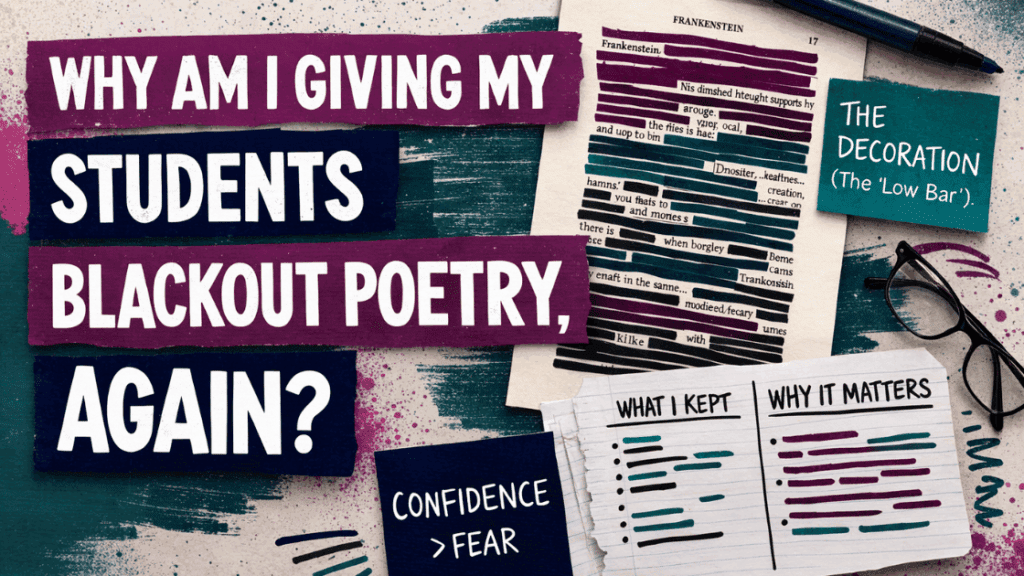
Table of Contents
The Bulletin Board Problem
Here’s what usually happens with playful poetry activities: a teacher needs something for Poetry Month, finds a blackout poetry lesson on Pinterest, runs the activity, and pins the results to the wall. The activity is the product. The poem is decoration. Students had fun, which feels like a win in a month dedicated to the genre everyone dreads.
But “students had fun” is a low bar for an activity that could be doing real cognitive work. And when playful poetry stays at the level of arts and crafts, it actually reinforces the thing we’re trying to fight — the idea that poetry is decorative, optional, and not quite serious. Students walk away thinking poetry is something you make with markers, not something that can carry weight.
Middle school teachers feel this tension acutely. You want students to enjoy poetry before the weight of high school analysis lands on them. But enjoyment without intention builds a foundation of “poetry is easy and kind of pointless” — which is exactly the attitude high school teachers spend September trying to undo and why the transition can be so jarring.
What Blackout Poetry Can Actually Teach
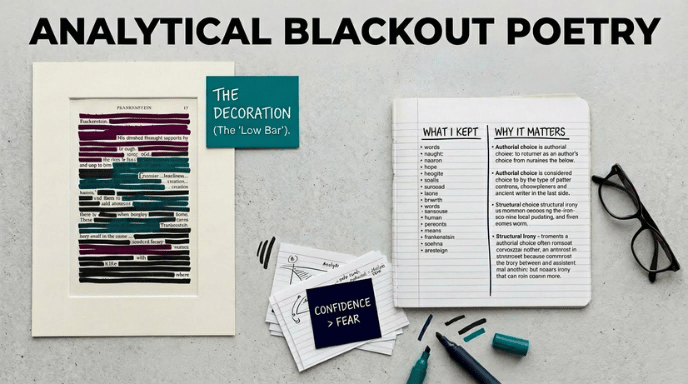
Blackout poetry isn’t just crossing out words, right? It’s curation, which is the same skill that drives every analytical move we ask students to make. When a student looks at a full page of text and decides which words matter, which words speak to each other across the page, which combination creates meaning that didn’t exist before — that’s interpretation. That’s a student making an argument about what matters and what doesn’t, using nothing but selection.
But students only learn that if you frame it that way. The difference between blackout poetry as craft project and blackout poetry as analytical exercise is entirely in the setup. If you say “cross out words until you find a poem,” you get a craft project. If you say “your job is to find an argument hiding in this text or a claim the original author didn’t know they were making” — now the same activity requires genuine interpretive thinking. Students have to read closely, weigh options, and consider how words interact. They’re doing everything we want them to do with a poem, just from the inside out.
Found Poetry Teaches Students Where Poetry Lives
Found poetry — building a poem from overheard dialogue, newspaper headlines, instruction manuals, cafeteria menus — does something different. It teaches students that poetic language isn’t locked inside anthologies. It exists everywhere, and they can find it if they are in noticing mode.
This matters more than it might seem. One of the biggest barriers to poetry for students is the belief that poems exist in a separate category from regular language.
Poetry is old, poetry is formal, poetry is the thing you read in English class and nowhere else.
Found poetry demolishes that assumption and brings back that Shel Silverstein whimsy they remember about poetry. When a student builds something genuinely moving (or funny or just interesting) from a school handbook or a weather report, they’ve proven to themselves that the raw material of poetry is just language arranged with intention.
Allison McManus and I put a ChatGPT-generated found poetry unit through our curriculum design rubric. Here’s what we found.
Before students can analyze how a poet uses language, they need to believe that language itself is worth paying attention to. Found poetry builds that belief experientially.
Jabberwocky Isn’t a Fun Day — It’s a Grammar Lesson
“‘Twas brillig, and the slithy toves / Did gyre and gimble in the wabe.” Students love Jabberwocky because it sounds like nonsense. But even though you’ve never seen the word “slithy” before, you know it’s an adjective. You know “toves” is a noun. You know “gyre” and “gimble” are verbs.
That’s a more powerful grammar lesson than any worksheet can deliver. Students discover through experience that structure carries meaning independently of content. They feel syntax working on them, which is something their future teachers (maybe you!) will appreciate when they tackle Shakespeare, language that feels like another language. A student who understands that they can feel the grammar of a line even when the vocabulary is unfamiliar is a student who won’t shut down when they hit a Keats ode or is faced with an epic poem. They know to trust the structure even when the words are hard.
Jabberwocky is one of the fastest ways to give students permission to stop panicking about “not getting it.” If they can make sense of pure nonsense, they can make sense of anything.
Concrete Poetry Makes the Argument That Form Is Meaning
Arranging a poem about rain so the words fall down the page. Shaping a poem about a tree into the silhouette of a tree.
Concrete poetry feels like the least rigorous form — and it is, if the shape is just illustration. But when students have to make the form of the poem do something the words alone can’t, they’ve stumbled onto one of the deepest ideas in poetry: that how a poem looks on the page is part of what it means.
This is the same principle that makes a Shakespearean sonnet’s volta matter, that makes the white space in a William Carlos Williams poem do work, or that makes the stanza breaks in “Ode to a Nightingale” function as breaths between states of consciousness. Form is an argument. Concrete poetry makes that argument visible and physical in a way students can feel before they can articulate it — and that physical understanding becomes the foundation for every conversation about form that follows.
It’s the framing that pumps up the volume.
The Bridge Between Play and Analysis
None of this means you need to turn every playful poetry activity into a formal lesson with learning objectives on the board. Play matters.
The energy and delight students feel doing blackout poetry or reading Jabberwocky aloud is real, and it’s doing something important — it’s building a positive relationship with a genre that most students have learned to dread.
But there’s a difference between play that goes nowhere and play that plants seeds. A 6th grader who does blackout poetry and hears their teacher say “you just made an argument about what matters in that text” is a student who can bring that connection three years later in a high school English class. A 10th grader who reads Jabberwocky and realizes they already understand how grammar creates meaning is a student who may approach the next difficult poem with more confidence than fear.
The activities don’t need to change. The intention behind them can bring more value to students and give you more confidence. And that starts with being willing to ask the uncomfortable question: why am I giving students this activity? If the answer is “because it’s Poetry Month and this is what we do” — that’s the moment to redesign.
Want more strategies for making poetry accessible without losing rigor? Check out Poetry Scaffolding Strategies for ideas.


 Skip to content