
You’re currently reading one stop in our Teaching Poetry Fest blog hop! When you’re finished, hop on over to Lauralee’s post about Poetry and Creative Writing for Your Students to keep the loop going, or visit the round-up post to take a look at all of the Teaching Poetry Fest ideas in one place.
Every English teacher has watched it happen. You hype yourself up for your toughest unit of the year. You hand students a poem you carefully chose, give them a few minutes to read, and ask what they notice. Silence. Or worse — someone offers “it rhymes” and the room collectively decides that poetry is not for them.
The instinct is to simplify. Pick an easier poem. Pre-explain everything. Turn the poem into a worksheet with fill-in-the-blank answers.
But your heart isn’t in that. You don’t want to beat them with the poem…and you know the problem was never that the poem was too hard. The problem is that students walked into it without the tools to know what they were looking at.
Scaffolding poetry doesn’t mean making poems simpler or forcing it into something mechanical. It means building the bridge between where students are and what the poem requires so that when they encounter something genuinely complex, they have a way into something genuinely interesting and compelling. Here are the strategies that actually work.
Table of Contents
Pair Song Lyrics with Poetry Before Students Read the Poem
We know students already analyze poetry. They just don’t know they’re doing it. Every time they explain why a lyric hits differently in context, why a bridge shifts the emotional weight of a song, or why an artist’s word choice matters — that’s close reading. They have the skill. What they don’t have is the confidence to apply it to a page of text written before they were born.
Pairing a song with a poem isn’t a gimmick or a way to make poetry “fun.” It’s a cognitive bridge. The song activates the same analytical thinking the poem requires, but in a space where students already feel competent. When I pair Hozier’s “Work Song” with Keats’s “Bright Star,” students discover they already have the skill to analyze poetry. Both texts deal with love that tries to outlast death and compress enormous emotional weight into tight, deliberate language. The difference is that students trust themselves with Hozier. By pairing it with Keats, that trust transfers.
I try to choose pairings that share genuine analytical DNA, not just surface-level thematic overlap. Eminem’s “Walk on Water” paired with “Ode on a Grecian Urn” isn’t just “both are about fame.” Both are about the cost of being frozen. Eminem is the untouchable legend who can only walk on water when it freezes, Keats’s lovers who are beautiful precisely because they’ll never actually arrive at the kiss. Students who see that connection in Eminem don’t need you to explain it in Keats. Part of what makes this work is students have background knowledge for Eminem that they can bring to their analysis, and for students who don’t, they sense where there is a story and they research to understand. Armed with a stronger understanding behind the lyrics they come to Keats primed.
Use Poetry Foundation Guides to Model What Close Reading Looks Like
One of the most underused free resources available is the Poetry Foundation’s poem guides. Each guide walks through a poem’s context, form, and key interpretive moves — essentially modeling the kind of close reading we want students to do. The analysis is right there, demonstrated by scholars who do this for a living.
I have students use these guides as annotation scaffolds. Before they attempt their own reading of a challenging poem, they read the Poetry Foundation guide alongside the text and annotate what the guide helps them see. I used to think this was cheating. But why? I read the guide myself and was then able to bring a stronger read, why would I keep this from my students? This is apprenticeship. We don’t expect music students to perform a concerto without first hearing how it’s supposed to sound. We shouldn’t expect students to close-read a poem without first seeing what skilled close reading looks like.
This works especially well with poems that resist quick understanding. Coleridge’s “Frost at Midnight,” for example, is a quiet, meditative poem that students often dismiss as “nothing happens.” The Poetry Foundation guide surfaces the conversational tone, the volta in the middle, and the way Coleridge weaves his sleeping infant into a meditation on imagination and nature. Students who read the guide first don’t just understand the poem better — they develop a model for how to approach the next difficult poem on their own. The scaffold is designed to come off.
Build Historical and Biographical Context Before the First Line
When students struggle with a poem, the missing piece is often not literary skill — it’s knowledge. They can’t read Blake’s “The Chimney Sweeper” as social critique if they don’t know what a chimney sweeper was, how old these children were, or what industrial England looked like. They can’t feel the urgency in Keats’s odes if they don’t know he was twenty-five, watching his brother die of tuberculosis, and almost certainly aware that the same disease was coming for him. Context is the lens that makes the poem legible.
The mistake is treating context as a warm-up — a quick slide of facts before “the real work” of reading. Context IS the work. When I teach Blake, students spend a full class period inside the historical world of child labor and industrialization and read alongside their investigation of the poem. When they’ve gotten all the context and found their final read of both versions of “The Chimney Sweeper” — the one from Songs of Innocence and the one from Songs of Experience — they’re not confused. They’re furious. And that fury is exactly the emotional and intellectual entry point Blake intended.
Sometimes we forget that contemporary readers are bringing a lot of knowledge that we do not have and that makes a difference.
The same principle applies to biographical context, but it has to be more than a Wikipedia summary. Keats didn’t just “die young.” He was a trained surgeon who chose poetry over a stable career, was savaged by critics who called him an uneducated pretender, fell desperately in love with a woman he couldn’t afford to marry, and wrote the most concentrated burst of great poetry in the English language while knowing his time was running out. When students have that story, even the ones that don’t have Hamilton running through their head as a comparison, every ode reads differently. The urgency makes more sense because they better understand, it’s a man trying to freeze beauty before his body fails him.
Use Film to Make Poetic Thinking Visible
Poetry asks readers to hold multiple meanings simultaneously, to sit with ambiguity, and to let images do emotional work that prose would over-explain. That’s hard to teach in the abstract. But film does exactly the same thing — a single shot can carry theme, character, mood, and symbolism at once. Students who learn to read film are sharpening the same skills that help them to read poetry.
Jane Campion’s Bright Star is the best film I’ve found for teaching Romantic poetry. I live it because it’s a beautiful biopic of Keats, and also because Campion shoots the film the way Keats writes poems. The camera lingers on light through fabric, on wind moving through a field of bluebells, on Fanny Brawne’s face as she processes what she can’t say. Students who watch those scenes and can articulate what the camera is doing are ready to articulate what Keats’s imagery is doing.
But film scaffolding works beyond individual poet studies. Any film that rewards close visual attention builds the same muscles poetry requires. The question isn’t “what movie goes with this poem?” It’s “what film teaches students to pay the kind of attention poetry demands?”
(But it is a bonus if it also helps them to understand historical context.)
Give Students a Focused Set of Lenses, Not an Overwhelming Toolkit
Traditional poetry instruction often front-loads a MASSIVE toolkit: meter, rhyme scheme, figurative language, sound devices, form, tone, diction. Dactylic, anapest, caesura, euphony…there are so many poetry specific terms that the terminology alone can be overwhelming.
Students dutifully identify iambic pentameter and then have no idea what to do with that information. They can label the devices but not explain why they matter. The toolkit becomes a scavenger hunt instead of a way of seeing.
What works better is giving students a small number of powerful lenses and going deep rather than wide. In my Romantic poetry unit, students learn four: the sublime, paradox, allusion, and negative capability. That’s it. Four concepts that unlock everything they’ll encounter — not just in Romantic poetry, but in literature broadly. A student who understands paradox doesn’t just “get” Blake’s paired poems of innocence and experience. They get the fundamental tension in Frankenstein, the complexity of any character who is simultaneously sympathetic and monstrous and the way great literature resists easy answers.
The lenses are cumulative. Each one builds on the last. By the time students encounter negative capability — Keats’s idea that great minds are “capable of being in uncertainties, mysteries, doubts, without any irritable reaching after fact and reason” — they’ve already practiced holding contradictions through Blake’s paradoxes and felt the overwhelming power of the sublime. Four lenses reinforced over and over again during our unit that pay off when we read Frankenstein.
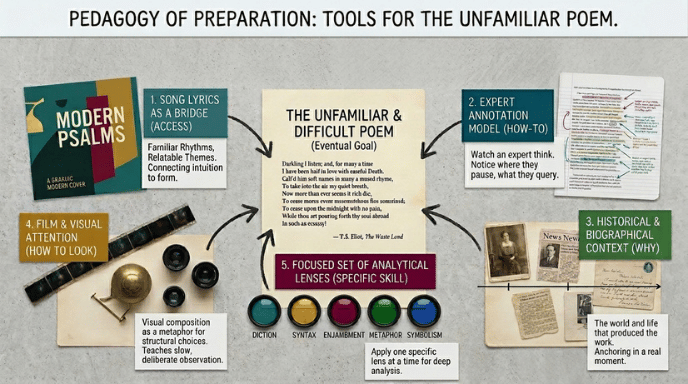
Song lyrics activate existing analytical skills. Poetry Foundation guides model expert reading. Context builds the knowledge the poem assumes. Film develops the kind of attention poetry requires. Focused lenses provide a framework for interpretation without reducing the poem to a single answer.
The common thread across all of these strategies make the student more capable after we finish the unit.



 Skip to content