
Every English teacher has a handful of poems they reach for when they need poetry to not feel like poetry. The ones that land on the first read. The ones that make the kid in the back row who hasn’t voluntarily engaged all semester look up from his phone and say “wait, that’s actually good.”
These poems matter more than we give them credit for. They’re not warm-ups or filler or “fun day” material. They’re doing essential work — proving to students that poetry is a living form that speaks to their actual experience, not a museum exhibit they’re forced to admire from behind a rope. The right accessible poem at the right moment can undo years of damage from bad poetry instruction. It can make a student willing to try Keats next week who would have shut down today.
Here are some of mine.
Table of Contents
William Carlos Williams: Poetry That Trusts the Image
“This Is Just to Say” is sixteen words of pure provocation. A man ate some plums from the icebox. He’s sort of sorry. That’s it.
Students laugh. Then they argue. Is it even a poem? Why is it famous? Wait, is it a man who ate the plums? What’s the point? And in that argument, they’ve already started doing everything we want them to do with poetry — questioning form, debating what counts as literature, paying close attention to word choice. “Forgive me / they were delicious / so sweet / and so cold” — is he actually sorry? Is this an apology or a confession? Is the sweetness the point or the coldness?
Williams is the poet who teaches students that poetry doesn’t require decoration. No metaphors. No mythological allusions. No archaic syntax. Just precise language about a specific, ordinary moment — and the trust that the image itself is enough. That’s a radical idea for students who’ve been taught that poetry means flowery language about big feelings. Williams says: the plums are enough. Pay attention to what’s in front of you.
“The Red Wheelbarrow” does the same thing in even fewer words. “So much depends / upon / a red wheel / barrow” — depends on it HOW? Williams never tells you. And that refusal to explain is itself a lesson in how poetry works. The poem creates a space for meaning without filling it in. Students who sit with that discomfort are practicing the same skill they’ll need for every ambiguous text they encounter.

Billy Collins: The Poet Who Teaches You How to Read Poetry
Billy Collins writes poems about reading poems. That sounds circular, but it’s exactly why he’s so useful in a classroom. “Introduction to Poetry” is the most effective first-day-of-a-poetry-unit poem I’ve found, because it names the exact problem you’re about to spend the unit solving.
Collins describes what he wants students to do with a poem — hold it up to the light, press an ear against its hive, waterski across its surface waving at the author’s name on shore. Each image is a different way of encountering a text: visually, aurally, playfully, with joy. And then the turn: “But all they want to do / is tie the poem to a chair with rope / and torture a confession out of it.”
Students recognize themselves immediately. They’ve been trained to extract meaning from poems the way you’d extract a confession — violently, impatiently, looking for the one right answer. Collins is saying: that’s not what this is. Poetry isn’t a code to crack. It’s an experience to have.
Reading this poem on day one gives you language for the rest of the unit. When a student asks “but what does it MEAN?” you can say “remember Collins — are you waterskiing or are you tying the poem to a chair?” It reframes the entire relationship students have with poetry from adversarial to exploratory.
Tom Wayman: The Poem That Makes Students Feel Seen
“Did I Miss Anything?” is the poem you read to your class and watch thirty faces light up with recognition. Wayman structures it as a response to the question every teacher hears after every absence — alternating between absurdly literal answers (“Nothing. When we realized you weren’t here / we sat with our hands folded on our desks / in silence”) and devastatingly sincere ones about what actually happens when someone isn’t present in a room where learning occurs.
The humor is the entry point. Students laugh at the sarcasm. But the poem lands harder than they expect, because underneath the comedy is a real argument about presence, attention, and what it means to show up.
For teaching purposes, Wayman does something technically interesting that students can identify without specialized vocabulary: the alternating structure creates a rhythm between irony and sincerity. Students can feel the tonal shifts before they can name them. That’s a gateway to understanding how structure creates meaning, the same principle that drives stanza breaks in odes and volta turns in sonnets.
Why These Poems Work (And What They’re Actually Teaching)
The common thread isn’t simplicity. Williams is making a radical philosophical argument about imagism. Collins is writing metapoetry that critiques how institutions teach literature. Wayman is using structural irony to argue for the value of human presence. None of these are “easy” poems. They’re poems that meet students where they are and then take them somewhere they didn’t expect.
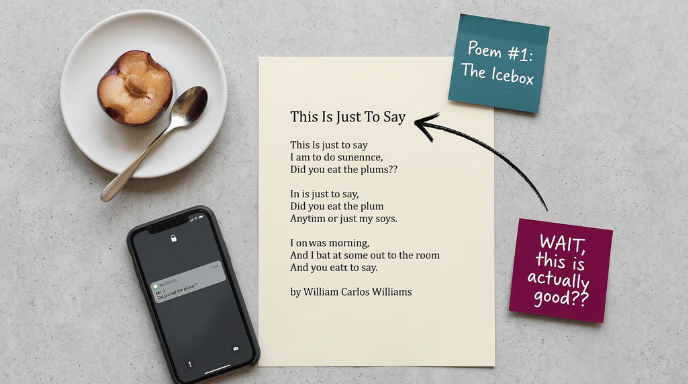
That’s the difference between accessible and dumbed-down. A dumbed-down poem removes complexity so students don’t have to work. An accessible poem uses familiar language and recognizable situations to smuggle in complexity students engage with before they realize it’s hard. By the time a student is debating whether “This Is Just to Say” is a real poem, they’re already doing literary analysis. They just aren’t scared of it.
When to Use Accessible Poems
The instinct is to front-load them — start with the easy stuff, then graduate to the hard stuff. That works, but it’s not the only play. Accessible poems are just as powerful dropped into the middle of a challenging unit as a palate cleanser. After three days of Romantic odes, reading “This Is Just to Say” can remind students that poetry also lives in the everyday, that not every poem demands the same kind of attention. It recalibrates.
They also work as the final text in a unit. After students have spent weeks building analytical skills with complex poems, handing them a Williams or a Collins and asking “so what’s this poem doing?” produces some of the best analysis of the semester. Students bring their full toolkit to a text that looks simple — and discover depth they wouldn’t have seen on day one. That discovery is proof of their own growth, and it’s more convincing than any rubric score.
The point isn’t to protect students from difficulty. It’s to build the confidence and the skills that make difficulty something they can meet. These poems aren’t the destination. They’re the proof that the destination is reachable.
Looking for more strategies to make poetry accessible without losing rigor? Poetry Scaffolding Strategies — covers five approaches that work across all levels.

 Skip to content