
There’s something about spoken word poetry. There’s a moment in Jason Reynolds’s For Every One where students lock in. It usually happens around the part where Reynolds talks about the fear — not the fear of failure, but the fear that what you want might actually be possible, and what happens if you go for it and it doesn’t work. Students actually get quiet, and not in a classroom-management kind of way. The first couple of times I was uncomfortable, because it’s long and I thought that pin-drop quiet was because of boredom, but the positive response afterwards was reassuring and has made this a poem I’ve used every year since.
That’s spoken word doing what page poetry often can’t: breaking through the performance of not caring that teenagers have perfected. Spoken word closes the distance between poet and listener in a way that feels immediate and personal. The poet is talking TO you. It’s also because the form is built on rhythm, repetition, and emotional directness, it bypasses the anxiety students bring to reading poetry on a page. There’s (seemingly) nothing to decode. There’s just a voice saying something that’s true.
But the real power of spoken word in a classroom can be in what it makes them willing to write.
Table of Contents
Why Spoken Word Poetry Lowers the Writing Barrier
I don’t need to tell you that many students have a deeply adversarial relationship with writing. They’ve spent years being corrected — grammar, structure, format, citation, thesis placement. For them, writing means rules, and rules mean the possibility of being wrong. The blank page isn’t an invitation. It’s a trap.
Spoken word disrupts that association because it doesn’t look or sound like school writing. There’s no five-paragraph structure, thesis statement, or works cited page. The “rules” of spoken word are rhythm, honesty, and the willingness to try to say something that matters. For students who’ve internalized the belief that their voice isn’t academic or correct enough for school writing, spoken word says your voice is the point.
For Every One: The Text That Moves the Room
Reynolds wrote For Every One as a letter to aspiring artists and anyone chasing a dream they’re not sure they’re allowed to have. It’s short enough to experience in a single class period. It’s honest enough to make students uncomfortable. And it’s structured as a direct address which means every student hears it as a personal conversation. The staging of the video also helps to create this liminal space where Reynolds is speaking to you, and only you.
What makes it work for writing instruction is that Reynolds models vulnerability without sentimentality. He talks about fear, doubt, and the gap between what you want and what feels possible. Students hear that you can be emotionally honest AND craft-conscious at the same time when they hear the rhythm and repetition in the poem. That combination is exactly what makes personal writing powerful rather than self-indulgent.
To be honest, after experiencing For Every One, the writing prompt almost doesn’t matter. Students are already there. They’ve heard someone put language around something they feel but haven’t articulated, and the impulse to respond and say “here’s MY version of that” is already active.
Moving From Spoken Word Poetry to Page Poetry
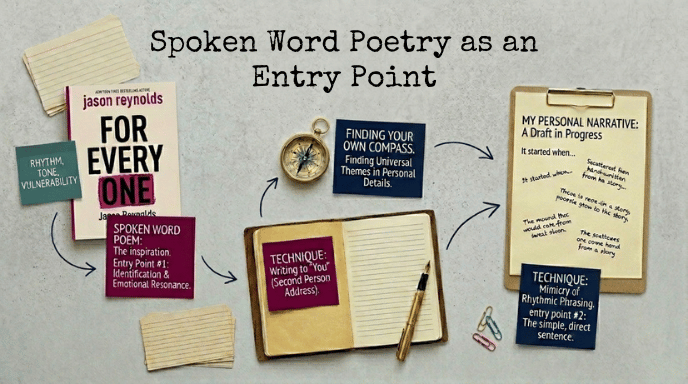
Spoken word is a bridge. Students who discover that they can write with rhythm, with repetition, with emotional directness have already learned foundational poetic techniques. They just learned them through their ears and their voices instead of through a textbook.
The teaching move is to name choices.
If you have them draft first, some students will naturally discover that they’ve been making the same choices poets make — about pacing, emphasis, structure, emotional movement — without any instruction on poetic technique. That discovery changes their relationship to page poetry. If they use Reynolds or others as a model they are primed to find the same moves in future poems because they’ve done it themselves.
The Bridge From Spoken Word Poetry to Personal Essay
Spoken word also opens a door to prose writing that traditional essay instruction often closes. Students who write a spoken word piece about their relationship with their grandmother have already done the hard part by identifying the emotional core and expressing their feelings.
Turning that piece into a personal essay is now a translation more than a genre shift. Helping them see the possibilities…that the rhythm can become sentence variety and repetition becomes motif and so on can help students write with more energy and specificity than students who start with an essay prompt, because they’ve already found their material.
Not Just for National Poetry Month
Spoken word is often mentally filed under “Poetry Month activities” alongside blackout poetry and haiku contests. That’s a waste, in my opinion. Any time students need to find their voice, access their experience, or build confidence with personal writing, spoken word can become the fastest route.
- The reasons icebreakers work is because they create a shared experience. (Some might say a shared experience of trauma, but alas.) For the beginning of the year, spoken word creates vulnerability in a structured form that feels safer than open sharing and helps to build classroom community when students don’t trust each other yet.
- In the middle of a challenging unit, when students are burned out on analytical writing — spoken word reconnects them to the reason language matters.
- At the end of the year, when you want students to reflect on growth, spoken word gives them a form worthy of what they have to say.
On the other side of a spoken word poem students can find writing that sounds like them and lead to their best work.
Want to use For Every One in your classroom? Inside my Teaching Poetry (When You’re Not a Poet) Toolkit, I pair Reynolds’s text with writing prompts and a spoken word workshop structure for a single class period.
Looking for more poetry scaffolding ideas? Check out Poetry Scaffolding Strategies: How to Make Challenging Poems Accessible Without Losing What Makes Them Challenging.
 Skip to content