
Why The Odyssey Now?
Christopher Nolan could make almost anything.
After Oppenheimer, he had the cultural and commercial capital that gives a filmmaker choices. Instead, for his next movie, he reached backward nearly 3,000 years for The Odyssey.
The obvious explanation is that The Odyssey is cool. There are monsters, shipwrecks, gods with grudges, a witch who turns men into pigs, a six-headed sea creature, a one-eyed giant, and a hero who returns home in disguise and eventually picks up a bow no one else can string. Nolan shot the thing entirely with IMAX film cameras. Of course he wanted The Odyssey.
But he has used a phrase to explain the choice that has really stayed with me. He said he was looking for “a gap in the culture.”
The word gap suggests an absence, something we need and are not getting. Which changes the question for me.
Not just why The Odyssey, but why The Odyssey now?
Table of Contents
The stories we need at the time we need them
Since I teach English, I spend an unreasonable amount of my life asking why we keep telling the same stories.
We call them timeless. It is one of those words teachers use so often that I am not sure we always hear ourselves say it anymore. Shakespeare is timeless. Homer is timeless. What we usually mean is that a story is still recognizable to us. People still want things they cannot have, and families still hurt one another. Fair enough.
But I am starting to wonder whether timeless is the wrong word and not just stories that exist outside of time. Maybe what we really mean are stories unusually capable of meeting the right moment, again and again.
The Greeks had two ways of thinking about time.
There is chronos, the time that passes, or the time we count. Chronos tells us that The Odyssey is old, a poem composed centuries before the common era, copied and translated and taught until Christopher Nolan can spend hundreds of millions of dollars putting it on a screen in 2026.
Then there is kairos: the opportune moment, time understood through significance rather than sequence. Kairos asks a different question. Why does this story meet us here?
Nolan’s “gap in the culture” is a kairos question. What might The Odyssey be able to say in this particular moment?
“Tell me about a complicated man”
Emily Wilson opens her translation with a line that has probably launched a thousand English teacher conversations.
Tell me about a complicated man.
The Greek word she is wrestling with is polytropos, and it has sent translators in a lot of different directions. Robert Fagles gives us “the man of twists and turns.” Wilson gives us “a complicated man.”
In a recent interview about translation, Homer, and the response to Nolan’s film, Wilson describes translation as a process with “several responsible ways” forward. Sound matters, and so do meaning, syntax, register, meter, and narrative perspective. A translator is making choices because all of those things cannot simply be lifted intact from Ancient Greek and dropped into English.
Nolan has cited Wilson’s opening line as one of the inspirations he carried into the film. And when he talked about his Odysseus in his New York Times interview, he made a comparison so immediately useful that I am almost annoyed I did not think of it first.
In Star Wars terms, Odysseus is more Han Solo than Luke Skywalker.
Of course he is.
Luke Skywalker enters the story asking to become a hero. Han Solo keeps insisting he isn’t one. Han is self-interested except when he isn’t, and loyal except when he leaves. He wants everyone to believe he has calculated every angle. Then he turns the Millennium Falcon around.
Odysseus is not Han Solo. Analogies have limits obviously, but the comparison does something useful: it interrupts our tendency to make Odysseus legible too quickly.
I think we do this to characters all the time in English class. Is he a hero? Is he a good leader? Was he justified? Pick a side and write five paragraphs about it.
But The Odyssey is remarkably resistant to a clean verdict.
Odysseus is clever. His cleverness saves lives, and his cleverness also needs an audience. He escapes the Cyclops by understanding the power of anonymity, then almost immediately shouts his name back across the water because apparently surviving is less satisfying if the monster does not know who beat him.
He wants desperately to return home. He also participates repeatedly in the delays that keep him from it.
He loves Penelope. The poem still requires us to talk about Circe and Calypso.
He is a veteran of a war that has taken twenty years of his life if you count the wandering. He is also a king returning to reclaim a household through extraordinary violence.
Tell me about a complicated man.
There is something almost defiant about us beginning there, because we are living through a moment obsessed with immediate moral legibility. We sort quickly into hero or villain, correct take or problematic take. The algorithms that mediate so much of our public conversation are not exactly built to reward “I am still thinking about it.”
The Odyssey gives us a man who has survived 3,000 years of storytelling partly because we have still not finished arguing about him.
We certainly do not need more morally questionable men at the center of stories. We are doing fine there. But we may need practice encountering contradiction without rushing to resolve it, and stories that ask us to hold more than one thing.
That might be part of the gap.
The more I think about xenia, the less I want to call it “hospitality”
While I have been thinking about Nolan’s Odyssey, I have also been doing the kind of reading I always end up doing when I start developing resources around a text. I thought I knew what I was interested in until I got into re-reading.
The more time I have spent with The Odyssey, the more interested I have become in xenia.
For years, I encountered xenia in the usual English teacher shorthand: the ancient Greek code of hospitality. Accurate, and also simple in an almost unhelpful way. “Hospitality” makes me think of fresh towels and whether I remembered to clean the bathroom before company arrives.
Xenia is doing much more serious work.
Imagine a world of travel without phones, photographs, identification cards, online reviews, or even a reasonable expectation that the person approaching your home can explain who sent them. A stranger arrives, and you do not know who he is or what he wants. In The Odyssey, you may not even know whether he is human.
What happens next?
Xenia creates order around that uncertainty. Both host and guest have obligations: food, shelter, gifts, safe passage, and questions asked in a particular sequence. The system works because the interaction does not begin with a personal assessment of whether the stranger seems worthy.
And this is the idea that I keep coming back to: Here is what I owe you before I know whether I like you.
That is a radically different way to think about xenia than “Greek hospitality,” and it feels extraordinarily timely.
What do we owe another person before we have categorized them? What about before an algorithm hands us a collection of evidence proving that they are exactly the kind of person we already suspected? What about after an algorithm has delivered a particular story about them but we haven’t actually met them yet?
The Odyssey comes from a world dramatically different from ours, and we can’t transliterate Greek life to ours. Homer does not have our answers. Homer does not even have our questions in exactly the same form.
But xenia understands something we still have to wrestle with.

A community cannot survive if every obligation begins after individual judgment.
Some rules have to come first.
That is why the violations of xenia in The Odyssey matter so much. When Polyphemus looks at the rules governing the treatment of strangers and says they do not apply to him, the poem is not describing bad manners; it is showing what happens when someone opts out of the shared code. The suitors are not just irritating houseguests who have overstayed their welcome; they consume the resources of a household while abusing the protection that allowed them to enter it. That is part of why the Phaeacians matter. They encounter a filthy, exhausted stranger with no proof of his identity, and they choose what civilized people do next.
Over and over, the poem asks a question that sits underneath the monsters and adventures.
What makes a group of people a community rather than a collection of individuals with competing appetites?
That might be another piece of the gap.
Maybe that is why the house matters so much
As I have been working on The Odyssey, I keep finding my way back to Book 1. That surprised me, because Book 1 is not where most people go when they are trying to prove The Odyssey is exciting. No one is buying an IMAX ticket because Telemachus has an uncomfortable conversation in his own house.
But the poem opens with a home whose rules have collapsed.
Odysseus is absent. Penelope is trapped inside a social and political problem she cannot solve by telling everyone to leave, and Telemachus is old enough to understand something is wrong but young enough that no one particularly cares what he thinks about it.
And the suitors, meanwhile, are eating him out of house and home. Literally.
The crisis at Ithaca is not that no rules exist. The crisis is that the rules have lost their force.
I teach high school, and I know ninth graders, and there is something familiar to me in watching a young person move through a system whose rules are partly written and partly invisible.
A ninth grader enters a new building trying to figure out what teachers mean by “participation,” and watching to see whether “late work is accepted” means late work is accepted, or means late work will be accepted with an expression that makes you regret your entire bloodline.
They are reading the room.
Telemachus is reading the room, too. His room just happens to contain 108 armed men eating his inheritance.
That parallel became the foundation for one of the first resources I built for the unit. Before students meet the suitors, Rules of the Room asks them to think about how communities decide what people owe each other, and what happens when everyone knows a rule but no one can enforce it.
I want students walking into Ithaca already thinking about systems, because then the suitors are not simply “the bad guys.” Students can see the system failing.
An old story enters a new time
There is another reason I keep thinking about xenia as Nolan’s The Odyssey approaches. The film itself has already become part of a fight about who gets to inherit an old story.
Nolan’s cast includes Matt Damon, Tom Holland, Anne Hathaway, Robert Pattinson, Lupita Nyong’o, Zendaya, and Charlize Theron, among others. The casting, the language in the trailer, and Nolan’s engagement with Wilson’s translation have already produced culture-war criticism.
Wilson talks about some of that directly in her Vulture interview. She knows something about people feeling protective of The Odyssey. Her own translation was celebrated in ways she found simplistic and attacked in ways she found equally revealing.
There is something worth sitting with in that protectiveness. We insist that The Odyssey is universal and timeless, a story that transcends its original moment. But the moment a new group of people appears to be participating in the telling, the boundaries of the story become very important. Who does this story belong to? How modern can the language become before the story has been changed too much?
These are not new questions. Translation itself forces them. In that same interview, Wilson points out that English and Ancient Greek never coexisted, and an English translation of Homer cannot simply transfer the original words untouched from one container to another. Every translation is a series of decisions about what must be protected.
A translator has to weigh meter against line count and register against ambiguity, choosing what to preserve and what to let go. You cannot preserve everything in exactly the same form, because the new language is not the old language.
Adaptation makes those choices visible in a different way. Filmmakers, translators, and teachers all receive the story before they hand it on to someone else.
And that brings me back to xenia.
What if retelling is a form of hospitality?
Stay with me.
A story arrives from somewhere else. It is old, and it has traveled, and it carries the marks of places you have never been and systems you do not entirely share. You invite it into your house.
What do you owe it?
You could treat preservation as your only obligation, refuse to touch anything, and try to make the story appear exactly as you imagine it appeared to the people who first encountered it. Except you cannot. The story has already traveled too far. You are reading it in English, in a mind shaped by 3,000 years of stories that came after Odysseus.
The story did not arrive in an empty house.
But the opposite approach is equally troubling. You could strip the story for parts, taking the Cyclops because he is fun and Circe because the students have heard her name, discarding whatever does not serve your immediate purpose.
The suitors, it is worth noting, also know how to consume what belongs to someone else’s house.
Maybe there is another option. Receiving an old story might mean listening to what it carries and making room for the parts that are strange, giving the story something from our own world before we send it onward.
Maybe adaptation is a kind of xenia. Maybe teaching is, too.
The Odyssey I want to send forward
I do not think my job as an English teacher and curriculum designer is to make The Odyssey relevant. The word has started to make me twitch.
“Make it relevant” too often means putting a 2026 costume on top of an old text so students will agree to look at it. You end up with lesson plans that reframe Odysseus as a TikTok influencer, or that rank the gods by imagined social media following.
I say this with love: I am tired.
The more interesting work is figuring out where the old story and this particular moment are already capable of speaking to one another. That has shaped the Odyssey resources I have been building.
I keep coming back to rules. Before students meet the suitors, I want them thinking about how communities decide what people owe each other, and what happens when everyone knows a rule but no one can enforce it.
I keep slowing down with Telemachus, because there is something worth staying with in the experience of being young inside a system you did not build, trying to determine whether you have any power to change it.
I spend more time with Calypso than most of the Odyssey materials I have encountered. “Odysseus chooses home” is a clean answer, and probably too clean. Calypso offers him immortality, beauty, comfort, and an escape from the body that has already endured war and will eventually fail him. He sits on the shore and cries. Then he leaves.
What exactly is he refusing? What does a person choose when he chooses a mortal home over an immortal life?
I want students to stay inside that question long enough that “Odysseus chooses home” stops sounding like the whole answer.
I keep returning to Ithaca, not just as the place Odysseus wants to reach but as a way to think about what makes a place home in the first place.
And through all of it, I am more interested than ever in the complicated man at the center. I do not need students to admire Odysseus. They may not. But I want them to resist the belief that understanding a character means arriving at a verdict, and to be able to say, “This is true. And this is also true. I have to build an interpretation big enough to hold both.”
That is what I mean by reading, and it is what I hope more ninth graders walk out of the year able to do.
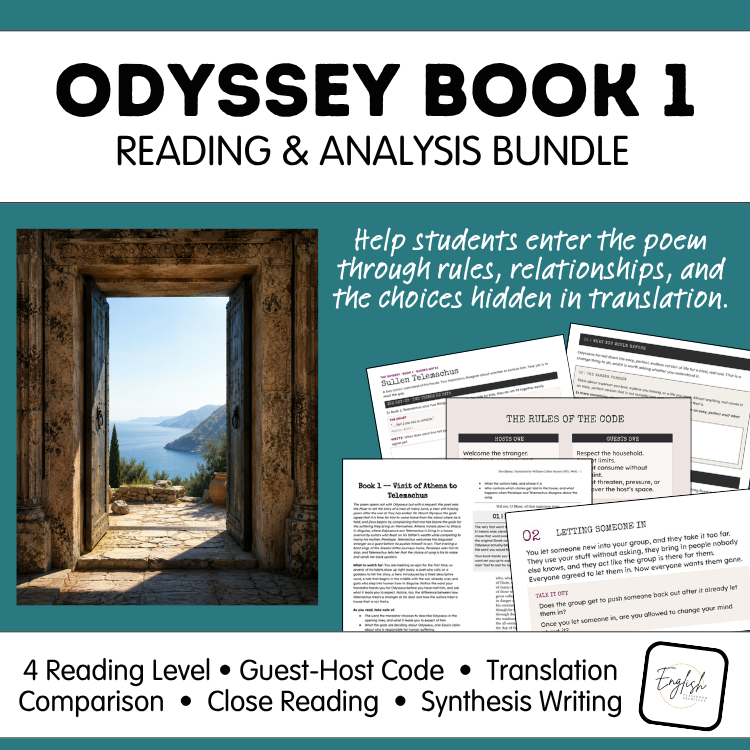
Chronos makes a story old. Kairos makes us open the door.
Maybe Nolan simply wanted to put a Cyclops on an IMAX screen. Honestly, fair.
But I keep coming back to his description of a “gap in the culture.” And I keep coming back to Emily Wilson’s first line.
Tell me about a complicated man.
Not a good man and not a simple hero, but a complicated one.
Then I look at a poem structured, in part, around ancient rules governing what we owe a stranger who arrives at the door. And I think about a culture that has become extraordinarily efficient at deciding who people are before we encounter them.
Maybe that is what “timeless” has always meant. Not that a story floats untouched above history, but that some stories are unusually capable of waiting for a moment they can meet, and arriving at another door.
Chronos makes a story old.
Kairos makes us open the door.

 Skip to content