
This is the first in a series exploring how speculative fiction has been preparing English teachers for the AI moment. Each installment, we’ll examine how classic sci-fi texts illuminate current educational challenges and point toward human-centered responses.
I’ve been a high school English teacher for 17 years.
The first time a student submitted an AI-generated essay to me, I knew it immediately. I didn’t need any detection software, and it was not because of obvious errors (or lack thereof). I knew because it didn’t sound like them. And it was terrible. It had no fingerprints, no pores.
When I talked to the student about it, they weren’t defensive. They were resigned. “I didn’t know what to write,” they said. “So I asked ChatGPT to help me start, and then…I guess I just let it finish. I didn’t know how to write the essay.”
That first conversation lives rent free in my head. It isn’t just that a student had cheated. We’ve dealt with plagiarism before. But because this felt different. They hadn’t copied someone else’s work.
The student had made a choice. They chose to avoid the kairos moments where thinking actually happens and default to chronos efficiency instead. They’d chosen productivity over process and outsourced their thinking, and they didn’t even realize what they’d traded away.
This reminds me of another story. When I was in high school, I took PreCalculus with Trig and did fine. I probably got a B+, maybe even an A-. I thought I had what I needed. I actually considered myself good at math. But when I got to college and took Calculus, I failed. Twice. Years later, I tried again out of pride…and I still couldn’t do it.
As an adult, determined to redeem myself in my head, I joined a free online course for Pre-Calculus to try to build a stronger foundation and eventually take the Calculus course again. I watched YouTube videos and asked questions from former students and athletes when I got stuck.
I slowly realized what happened back in high school. I’d never really learned Trigonometry. I didn’t learn something critical and I didn’t even know what I had missed. That experience has stayed with me—not because I didn’t become a math major, but because I spent years with that failure nagging me.
What haunted me wasn’t the failure itself—it was the time I thought I had spent learning that turned out to be time spent performing learning. I had optimized for chronos (getting through the material, earning the grade) while missing the kairos moments where real understanding crystallizes.
Now I look at how students are using AI, and I feel that same knot in my chest. Because AI can make student work look “finished.” It can fill the page, check the boxes, generate a passable thesis. But it doesn’t build the skills they’ll need when thinking actually matters. It gives them the illusion of fluency.
And unless someone teaches them to hear the difference, they won’t realize what they’ve skipped until it’s too late.
The Cost of Being Early
Here’s what I realized: I’d been preparing for this moment my entire career without knowing it.
When I was a kid, we were the first people on our block to have rollerblades. My dad was an English major who ended up working in tech—always ahead of the curve. We were the house with the early internet, the weird gadgets, the futuristic thinking. And I inherited that mindset.
When something new appears—especially something with big implications—I don’t wait for consensus. I want to understand it. Break it apart. See how it works.
That’s why I started experimenting with AI early, even when the outputs were rough. I knew it was coming, and I wanted to meet it on my terms. But being early comes at a cost. It means seeing problems before they’re widely acknowledged and carrying that discomfort alone.
Being early means living in kairos when everyone else is stuck in chronos. While others follow the scheduled timeline of adoption—wait for consensus, follow the implementation plan—you’re operating in the time of opportunity, the time of recognition, and the time of necessary action.
In this way, being early is also a gift. Because when I started rereading the books I’d been teaching for years, I realized something unsettling: the stories weren’t metaphors anymore.
I didn’t start reading science fiction to prepare for the future. I read it to escape the present. The worlds were comfortably distant—dramatic enough to feel thrilling, detached enough to feel safe.
But now? The metaphors are getting too literal. The questions are getting way too close. I’m sure you’ve felt this.
When Future Becomes Present Tense
We are living in a dystopian novel in more ways than one: Asimov’s robots caught between impossible contradictions. Card’s students trained for the wrong war. Shusterman’s systematic removal of human messiness from complex decisions. What used to feel like fantasy now feels like footnotes to our staff meetings.
The weird part is that we’re the ones who should be ready. English teachers.
We’ve always taught students to imagine alternative futures. To think through cause and effect. To ask what’s missing, who’s missing, what happens if we don’t change. We’ve taught them to interrogate systems, read subtext, and hold uncomfortable truths in tension.
We’ve been teaching literary preparedness. We just didn’t expect the simulation to show up during fourth period.
Literature has always been about kairos—the perfect moment when a story reveals something essential about human nature. But education increasingly operates in chronos—pacing guides and standardized timelines. The AI crisis is forcing us to choose: Do we teach in meaningful time or mechanical time?
What COVID Taught Us About Educational Time
This is the educational moment we’re in. AI isn’t coming to schools—it’s already here. In our students’ pockets. In their study habits. In the emails suggesting we use it for lesson planning. In the professional development sessions where someone inevitably says, “This will save you so much time!”
Time for what, exactly?
When the pandemic hit, we didn’t get to pause—we got told to pivot. We adopted tech, threw out policies, rewrote grading systems on the fly. And what struck me wasn’t how fast everything changed, but how little we understood why we were doing any of it.
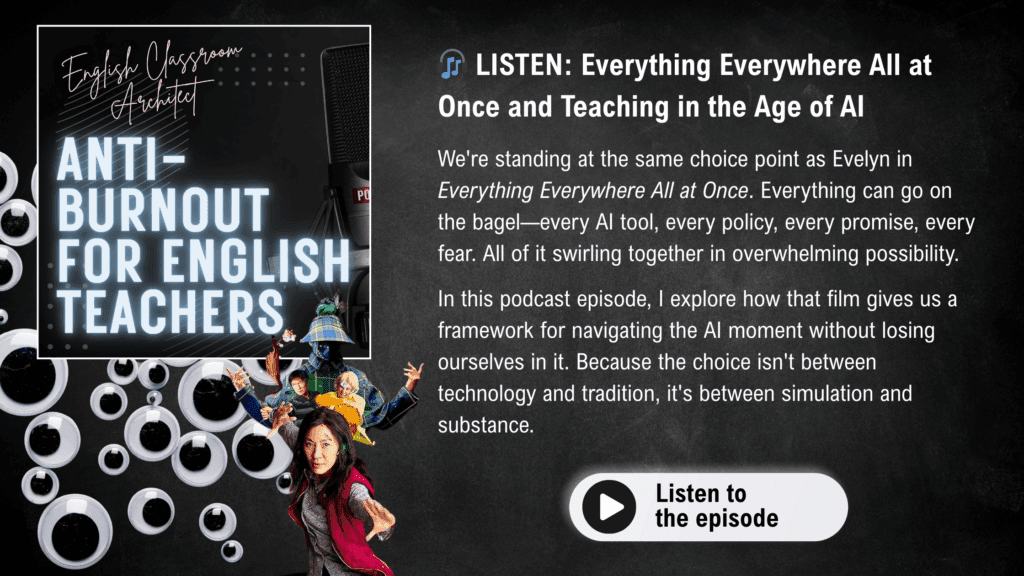
The world was chaotic, and school became a mirror of that chaos—shiny tools with no scaffolding. We were supposed to act normal in a world that clearly wasn’t.
We were forced into kairos —the time of crisis, of opportunity, of essential decision-making. But instead of embracing that meaningful time, we tried to restore chronos as quickly as possible. We wanted normal schedules, normal assignments, normal metrics. We mistook the return to mechanical time for the return to actual learning.
So when we came back we didn’t really talk about what happened. Not in ways that were helpful anyway. No real post-mortem. No honest inventory of what we lost and what we learned. We just moved on. For the most part, we ran back to the welcoming arms of the same systems and structures. Like nothing happened.
Now AI is here, and I’m watching it happen again. Well-meaning people making smart-sounding suggestions that feel like echoes of patterns we never had the courage to interrupt.
We didn’t just fail to learn from COVID. We misunderstood the problem entirely. We focused on what was lost rather than asking the harder questions: Why did our structures fall apart so quickly? What makes the classroom work beyond the screen?
And now AI is presenting us with the same choice point. Will we learn from disruption or just try to restore familiar systems?
Why English Teachers Are Dragon Trained
Here’s what I realized when I first started experimenting with AI: I already knew how to handle this. Not because I’m a tech expert, but because I’m an English teacher.
AI is like having a conversation with someone who has read everything but experienced nothing. It can make connections across vast amounts of information, but it doesn’t know what any of it means in the specific, human, right-now reality of your classroom. It is the slick-talking dragon of our generation.
That gap between information and understanding, between pattern and meaning is where our expertise lives.
Every skill we teach in English class is actually a skill for critical AI use. We don’t need to learn new competencies—we need to apply the ones we already have:
- Close reading reveals what AI gets wrong or oversimplifies
- Rhetorical analysis exposes how AI constructs arguments without understanding
- Voice recognition helps us spot when outputs lack authentic perspective
- Source evaluation catches AI’s confident hallucinations
- Multiple perspectives pushes beyond AI’s algorithmic defaults
We don’t need to become tech experts. We already are the experts. We just need to apply our English teacher lens to this new reality.
How do we use AI? That’s the wrong question. The real task is learning to see through it. And that’s something English teachers have been training for our entire careers.
What This Series Is Really About
To be clear: I’m not anti-AI. I wrote this series because I’m pro-thinking. And because the stories we’ve been teaching have been preparing us for this moment all along.
This isn’t an anti-AI manifesto or a “101 Ways to Use ChatGPT” guide written by someone who hasn’t stood in front of teenagers in years. This is about reclamation:
- Reclaiming your professional judgment when everyone wants to automate it
- Reclaiming your teaching voice when templates feel safer
- Reclaiming your ability to pause and say, “This doesn’t feel right”
- Reclaiming the space to teach like a human being, not a content delivery system
Speculative fiction has always been our early warning system—writers imagining what happens when we optimize for efficiency over wisdom, when we mistake performance for substance, when systems override human judgment.
Teaching in the Time That Matters
The time you spend now—on clarity, on courage, on craft—is not wasted. It’s time well spent. It’s how you hold your ground when systems won’t. It’s how you show students what it looks like to stay human when everything pushes toward standardization.
This entire series is about reclaiming kairos in a profession increasingly dominated by chronos. It’s about finding the perfect moments to pause, to question, to choose wisdom over efficiency. Because when we teach in mechanical time, we train students to think mechanically. When we teach in meaningful time, we show them what it means to be human in an algorithmic world.
Because whether or not you use AI, your students will. Whether or not you plan with it, your district will have opinions about it. The question isn’t whether to have an opinion about AI. The question is whether your opinion will be shaped by your values or by your exhaustion.
This series is for teachers who choose values and who refuse to become cogs in someone else’s machine. Who believe teaching is fundamentally a human act.
Over the next few weeks, we’ll explore exactly how the stories prepared us for this moment and what they’re telling us to do next. If you’re ready to reclaim your professional judgment and protect what makes teaching human then you’re in the right place.
The stories tried to tell us. Now it’s time to listen.


 Skip to content