
Table of Contents
A teacher named Paul Darvasi wanted to stress his students out.
He was teaching One Flew Over the Cuckoo’s Nest and wanted students to feel what it’s like inside an oppressive, stressful institution, and he wanted to simulate the confusion, the surveillance, and the arbitrary authority of the setting.
So he designed something called the Ward Game. It’s a pervasive game (a game that exists in the real world) where he turned his classroom into a living video game. Students received missions and tasks for points. Communication happened through multiple channels. Throughout the game the expectations shifted. The rules were stable but the system felt unpredictable. He played the Big Nurse and controlled everything, just like the novel.
And the structure he used? Multiple varied tasks. Different formats. Point values. Students selecting, sequencing, managing competing demands.
He built a choice board.
That’s what stress looks like architecturally.
A colleague and I loved the idea. We contacted Darvasi, he generously shared his plan with my team, and we adapted to create a version of it. It was really fun and did exactly what it was designed to do. They understood the stress the characters of the novel felt and many got into the game play.
Here’s the irony: we’d probably reject the Ward Game now. Even though we were really clear it was a game, and even allowed students to opt-out, the idea of purposely stressing students out probably wouldn’t go over well. It’s a different time and this is too intense, not trauma-informed, potentially bad for student mental health. A victim of cancel culture we can see coming.
But we hand out choice boards every unit thinking we’re being kind.
It’s the same cognitive architecture. One is honest about what it’s doing and the other pretends it’s gentle.
Here’s a choice board I used to give my students:
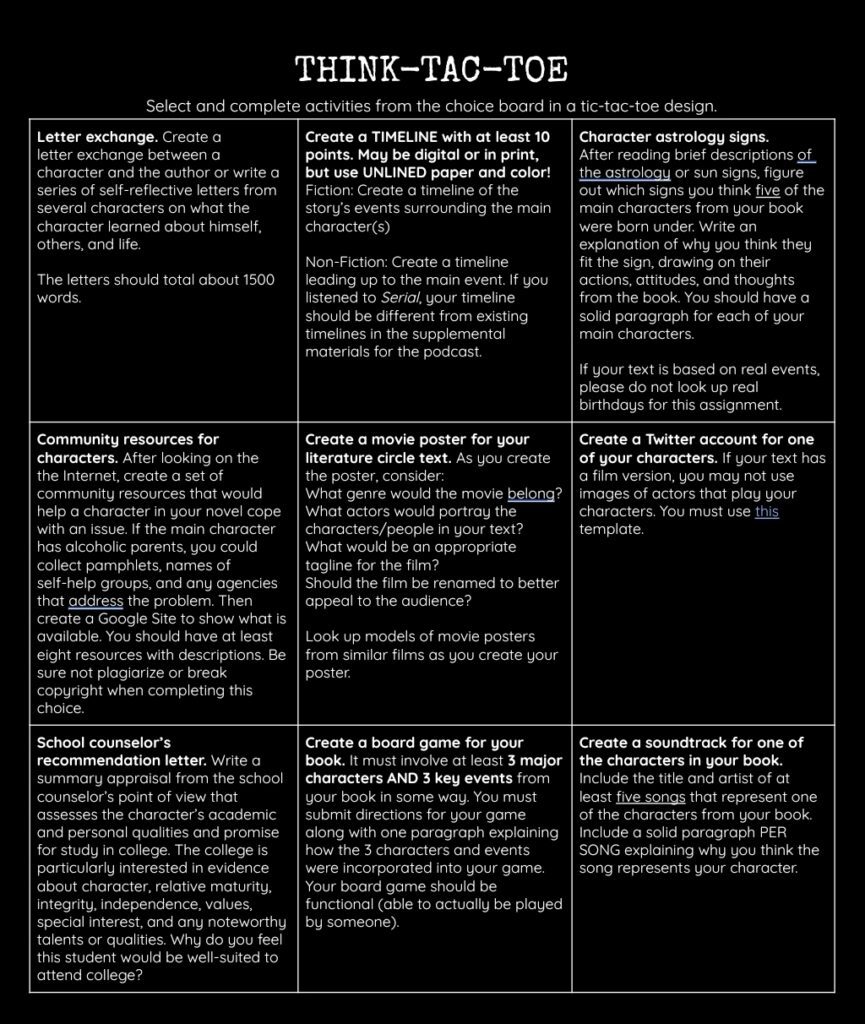
Letter exchange. Timeline. Character astrology signs. Community resources. Movie poster. Twitter account. Counselor recommendation letter. Board game. Soundtrack.
When I initially gave this assignment, what I thought I was doing was offering flexibility and honoring different learning styles. We were told to give students agency, and I thought this was it. Nine options!
But as students started to work on it I started asking uncomfortable questions.
When did I teach game design? When did I teach how to write a counselor recommendation letter? When did we practice creating community resource guides?
I was assessing skills I never taught.
And what were students actually choosing? Not necessarily the option that pushed their thinking. The option that felt easiest. Most often with choice boards it was the format they already knew. And look, I get that that’s the point of UDL (Universal Design for Learning), but when what we teach as a discipline is actually the format itself, that gets a little muddy.
As I look at this choice board I wonder what I’m even assessing. These choices are so different.
Meanwhile, the student who had gone down a rabbit hole, who had maybe read a connected book, researched the historical context, or made connections I didn’t assign, had nowhere to bring that. The board didn’t reward engagement. It rewarded knowing how to make a poster.
I really thought I was reducing stress because I’d been told that was good pedagogy. But I was CREATING cognitive stress, just without the honesty of the Ward Game.
Choice Board Cognitive Design Problems
There are (at least) three things wrong here:
1. Scattered cognitive operations.
Letter writing is not timeline creation is not soundtrack curation is not game design. Each requires different thinking. If you taught close reading and analytical writing all unit, and then your assessment is “make a board game,” you’re not assessing what you taught. You’re assessing who already understands how board games work.
2. Choice in format, not content.
When I’m coaching my track team, if there is a student with an injury we want the athlete to do the closet possible activity possible that doesn’t aggravate their injury. So if the team is doing something aerobic, we’re not going to have the athlete stretch. Those serve entirely different purposes. But we might have them do a circuit workout where they raise their heart rate and maintain it at the same intervals as the rest of the team. The point is the aerobic activity.
There is no center to this set of assignments, no equivalent to “aerobic activity.” All students should have some cognitive coherence.
So, here’s the thing. The more I’ve tried and thought about this, the more I’m unsure this type of choice board is even fair unless they are choosing among choices they have already practiced and performed in my class.
3. No payoff for engagement.
What are we actually assessing here? The student who thought deeply about the unit and went above and beyond bringing in outside knowledge…where does that go? Nowhere on this board. There’s no option that says “bring what you learned.” The board rewards format skills, not intellectual depth.
The Differentiation Problem
There’s a bigger issue underneath choice boards, and it has to do with how we think about differentiation in the first place.
When most teachers hear “differentiation,” we think about the bottom. We think about scaffolds and supports and “How do we help struggling students access the content?” That’s where the training is. That’s where the mandates are so that’s where the energy goes.
And that matters, for sure. Those students deserve access.
But “ALL learners” includes everyone. It also includes the student who finished early and is now waiting, the student who’s capable of more but learned that “good enough” is enough, and the student who went down a rabbit hole on their own and has nowhere to bring what they found.
Differentiation should stretch in both directions and give students both access AND depth. But most of our tools only push one way.
Choice boards are a perfect example. The logic is: give students multiple entry points, honor different learning styles, reduce barriers. That’s access thinking. And it makes sense if the goal is making sure everyone can demonstrate understanding.
But what about the student who’s ready for more? What does the choice board offer them? Usually: the same nine options everyone else has. The same ceiling. The same cognitive tasks we never taught.
In English, this gets even messier. Our discipline IS the format. We teach writing. We teach analysis. We teach close reading and argumentation. When we offer “make a poster OR write an essay OR create a soundtrack,” we’re not just offering different entry points, unless we’ve taught all of those formats we’re abandoning the actual skills we spent the unit teaching.
That might be fine in other disciplines. But for us, format choice often means discipline abandonment.
So what would it look like to differentiate in a way that stretches students who are ready while still assessing what we actually taught?
The Key Question
The Ward Game worked because the stress served the learning. The cognitive disorientation WAS the interpretation. Students felt the institution in their bodies. Their analysis was amplified by their experience.
Most choice boards don’t have that excuse. The stress is just overhead. Students are managing logistics—evaluating options, predicting workload, comparing formats, sequencing tasks—and none of that serves the intellectual work.
So what I started asking myself is what is the stress in my choice board doing?
Is it advancing meaning? Reinforcing theme? Supporting transfer?
Or is it making students manage logistics and split thinking?
If the stress isn’t serving the learning, you’ve designed the Ward Game without the payoff.
Where I’ve Landed With Choice Board Design
Flip the choice and give the same cognitive operation with different content.
Here is what I’m thinking now. In this video I walk through my entire “no stress” enrichment system, including how this kind of choice board fits into a larger architecture:
Everyone does the same intellectual work – the skill you actually taught during the unit. If you were building skills towards an essay, students create that. If it was learning about the structure and art of podcasts, students create that. But students bring different expertise to that work based on what they explored during the unit.
Say your unit was Frankenstein. You taught analytical discussion and practiced making claims and supporting them with textual evidence.
Your “choice board” becomes: facilitate a small group conversation about one of these angles explored during the unit.
- Option 1: The Creation and Milton’s Satan—what does the allusion reveal?
- Option 2: Science and responsibility—what is Shelley arguing?
- Option 3: Book connection—how does an independent reading text you read illuminate something in Frankenstein?
- Option 4: Historical context—how does what you learned about the Romantic period change how you read a key scene?
- Option 5: Film/media connection—how does an adaptation or related text you explored deepen the novel’s themes?
Same task: facilitate a conversation, make claims, use evidence.
Different doors: based on what the student explored and has something interesting to say about.
How This Creates More Productive Choice
In this model, everyone is doing the same cognitive work. No one is making a board game while someone else writes an essay. The skill you taught is the skill you’re assessing.
But students who engaged more deeply have more to bring and the choice allows their expertise to become visible.
And for you, you have one rubric and one type of assessment. You’re assessing the same skill across different content. Instead of grading posters against letters against board games.
Choice boards aren’t bad because choice is bad. They’re bad when the cognitive load is accidental and variation exists for “engagement” but doesn’t serve the intellectual work.
We can still give students agency. We can still differentiate. But design the choice around what they bring—not how they package it.
And we have to be honest about what we’re building. If we wouldn’t run the Ward Game, we shouldn’t hand out its architecture and call it flexibility.


 Skip to content